MAGAZIN CULTURE Journal
“Grigory Bosenko is professionally multifaceted and ubiquitous. He knows a great deal and reflects with interest. He is persistent in embracing the faith he has chosen. I remember how, once, having been ‘caught’ betraying painting and architecture for design, he energetically demolished the consumerist notion of his fascination with design. But before that there had been several very productive periods when he engaged in the most diverse forms of art.”
R. Kazakova
On 5 December, a solo exhibition by Grigory Bosenko opens in Chișinău.
“Architecture is my first love,” the artist himself admits. He graduated from the Faculty of Architecture of the Chișinău Polytechnic Institute. He designed numerous public buildings; the most interesting of them were the project for a children’s animation studio and the “International House of Republican and Union Tasting.” Both, unfortunately, were never realized, since the client at that time was the republic’s top official, who was soon removed from office. However, at the architectural-design stage, these works and the interiors for the Central Committee building were awarded a diploma in the All-Union competition of projects by young architects.
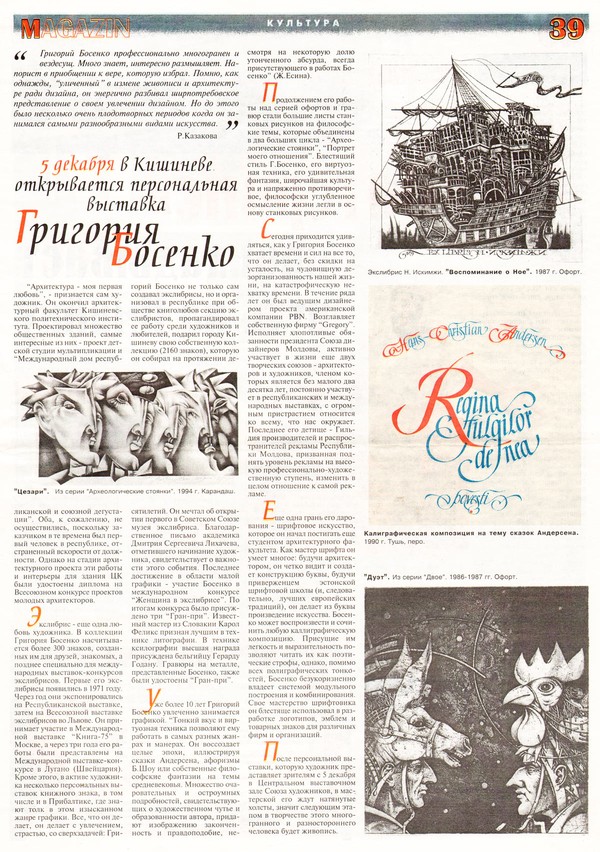
The ex libris is another of the artist’s loves. Grigory Bosenko’s collection contains more than 300 bookplates created by him for friends and acquaintances and later specially for international ex libris exhibition-competitions. His first ex librises appeared in 1971. A year later they were displayed at a Republican exhibition, and then at the All-Union Ex Libris Exhibition in Lviv. He took part in the “Book-75” International Exhibition in Moscow, and three years later his works were presented at the International Exhibition-Competition in Lugano, Switzerland. In addition, the artist’s record includes several solo exhibitions of bookplates, including in the Baltic states, where this refined graphic genre is well understood. Everything he does, he does with enthusiasm and passion, with a higher purpose: Grigory Bosenko not only created ex librises himself but also organized an ex libris section in the republic under the Society of Book Lovers, promoted its work among artists and enthusiasts, and donated his own collection to the city of Chișinău (2,160 bookplates), which he had assembled over decades. He dreamed of opening the first ex libris museum in the Soviet Union. A letter of appreciation from Academician Dmitry Sergeyevich Likhachev, who noted the artist’s initiative, testifies to the importance of this event. Bosenko’s latest achievement in the field of small-format graphic art was his participation in the international competition “Woman in the Ex Libris.” Three Grand Prix awards were presented following the competition. The renowned Slovak master Karol Felix was recognized as the best in lithography. In wood engraving, the highest award went to the Belgian Gerard Godan. The metal engravings submitted by Bosenko were also awarded a Grand Prix.
Grigory Bosenko has been passionately engaged in graphic art for more than ten years. “His refined taste and virtuoso technique enable him to work in a wide variety of genres and manners. He recreates entire eras, illustrating Andersen’s fairy tales, the aphorisms of Bernard Shaw, or his own philosophical fantasies on medieval themes. A multitude of charming and witty details, testifying to the author’s artistic intuition and erudition, lend the image completeness and verisimilitude, despite a certain measure of refined absurdity, which is always present in Bosenko’s works” (Zh. Yesina).
His work on a series of etchings and engravings was continued by large sheets of easel drawings on philosophical themes, united in two major cycles-“Archaeological Sites” and “A Portrait of My Attitude.” G. Bosenko’s brilliant style, his virtuoso technique, his remarkable imagination, his broadest culture, and his intensely contradictory, philosophically profound comprehension of life formed the foundation of these easel drawings.
Today one can only wonder how Grigory Bosenko finds enough time and strength for everything he does, without making allowances for fatigue, the monstrous disorganization of our lives, or the catastrophic lack of time. For a number of years, he was the lead designer of a project for the American company PBN. He heads his own company, “Gregory.” He performs the demanding duties of president of the Union of Designers of Moldova, actively participates in the life of two other creative unions-the architects’ and artists’ unions-of which he has been a member for almost two decades, regularly takes part in republican and international exhibitions, and approaches everything around us with enormous passion. His latest undertaking is the Guild of Advertising Producers and Distributors of the Republic of Moldova, intended to raise the level of advertising to a high professional and artistic standard and to change the overall attitude toward advertising itself.
Another facet of his talent is the art of type, which he began to study as a student at the Faculty of Architecture. As a master of type, he can do a great deal: as an architect, he clearly sees and creates the structure of a letter; as an adherent of the Estonian school of type (and, consequently, of the finest European traditions), he turns a letter into a work of art. Bosenko can reproduce and devise any calligraphic composition. Their inherent lightness and expressiveness allow them to be read like poetic stanzas; yet, in addition to all the subtleties of printing, Bosenko has an impeccable command of the system of modular construction and combination. He brilliantly applied his skill as a typographer to the development of logos, emblems, and trademarks for various firms and organizations.
After the solo exhibition that the artist is presenting to viewers from 5 December at the Central Exhibition Hall of the Union of Artists, stretched canvases await him in his studio, which means that the next stage in the work of this multifaceted and versatile person will be painting.
Captions to the illustrations:
“Caesars.” From the “Archaeological Sites” series. 1994. Pencil.
Ex libris of N. Iskimji. “Memory of Noah.” 1987. Etching.
Calligraphic composition on the theme of Andersen’s fairy tales. 1990. India ink, pen. Inscription in the composition: Hans Christian Andersen / Regina fulgilor de nea / bosenko.
“Duet.” From the “Two” series. 1986-1987. Etching.