Articles and Publications

ARTICLES PRESS PUBLICATIONS PUBLICATIONS ABOUT G. BOSENKO

Articles

The Development of Innovative Ergodesign-Oriented Design Is a Necessity of Our Time
At present, the traditional understanding of the word “design” is changing dramatically. In its essence, design is no longer merely the shaping of the material world around us. Its scope is becoming far broader. Design is turning into a global instrument, pushing aside marketing and sociology. It is moving into the deeper levels of research.
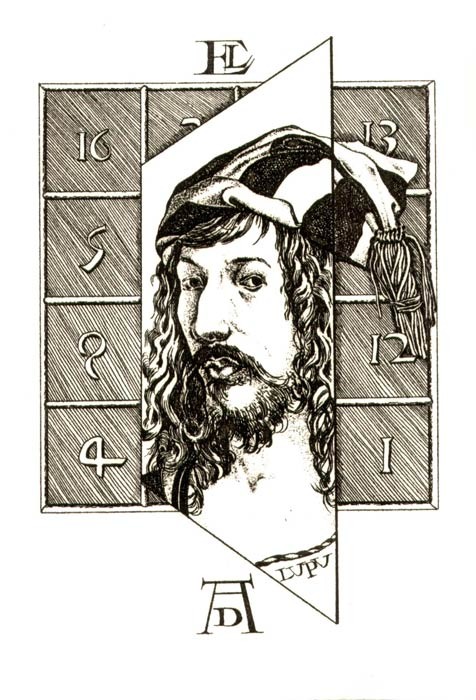
Small-Format Portraiture in Engraving and the Bookplate “Russian Bookplate Journal”
When considering the theme of portraiture within the broad spectrum of the bookplate, it is necessary to analyse the portrait canon, study the work of masters of miniature portrait engraving from a historical perspective and the work of contemporary masters of this genre, as well as trace the development of portrait imagery in the modern bookplate.
The National Culture of the Gagauz People in the Bookplates of Petr Plakh “Russian Bookplate Journal”
Petr Nikolaevich Vlakh was born in 1945 in the city of Comrat, Moldavian SSR. He graduated from the I. E. Repin Republican Art School in Chișinău and the Ivan Fedorov Lviv State Institute of Printing. The artist created approximately one hundred bookplates dedicated to the contemporary culture of the Gagauz people.
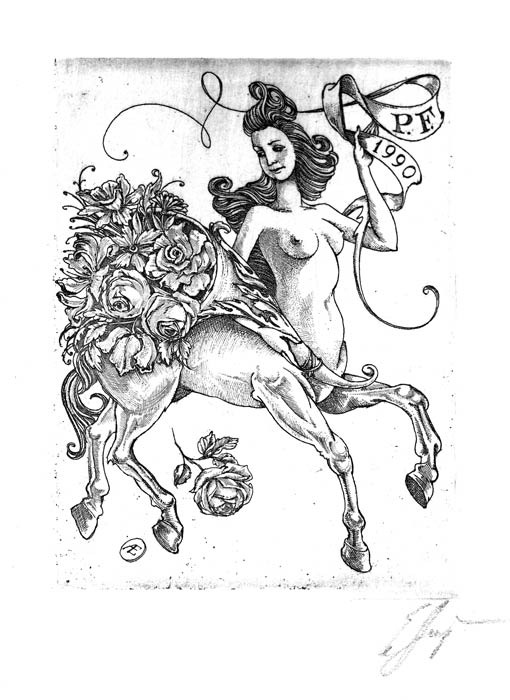
New Year’s Greeting Engraving - PF (pour féliciter) “The Bibliophile’s Almanac”
For many years, such an intimate genre of small-format graphic art as the New Year’s greeting engraving, the so-called “PF” (pour féliciter), which translates from French as “for congratulating,” has existed (with a tendency to fade away). What makes this small miniature unique? The singularity of its original source? The primacy of the original? Its handmade nature, or the close connection between the gift of the artist’s imagination and the initiator of the greeting? A greeting engraving is produced on commission from a private individual or an organisation, as well as by an artist for personal greetings.
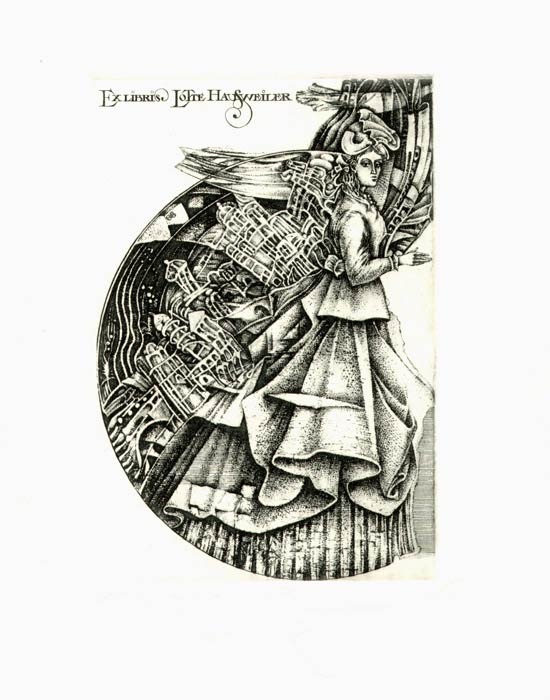
Essay “Architecture” in the Bookplate /G. Bosenko’s Creative Method/
From approximately the 1960s, with the development of book production, interest in the bookplate began to awaken everywhere. Bibliophiles and artists increasingly began to recognise their profound connection with the multifaceted nature of culture. In essence, during the Thaw, the younger generation rediscovered “its own culture,” art and literature. A need arose to classify, preserve and mark private libraries. The ex libris bookplate was revived.
Vladimir Sheiko’s Typographic Symphony “Russian Bookplate Journal”
Today, Vladimir Sheiko’s art may be judged primarily by his bookplates and small-format presentation graphics. In this field, he revealed and fulfilled himself completely. Sheiko is steadfast in his pursuits and serves only three muses: television, where he has worked for approximately forty years; the bookplate; and the collecting of bookplates and stamps.
The Spiritual Experience of the Artist Nikitin
Leonid Stepanovich Nikitin was born in 1939 in the city of Znamianka, Kirovohrad Region. He graduated from the Ivan Fedorov Lviv State Institute of Printing in 1967. A recognised master of the bookplate, he cut approximately one hundred bookplates distinguished by the filigree precision of their lines, the originality of their compositional solutions and their elegance.
Architect Valentin Voytsekhovsky
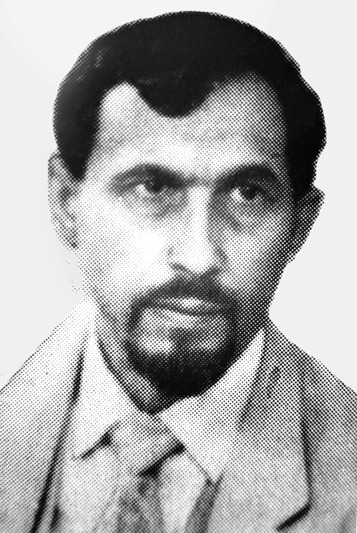
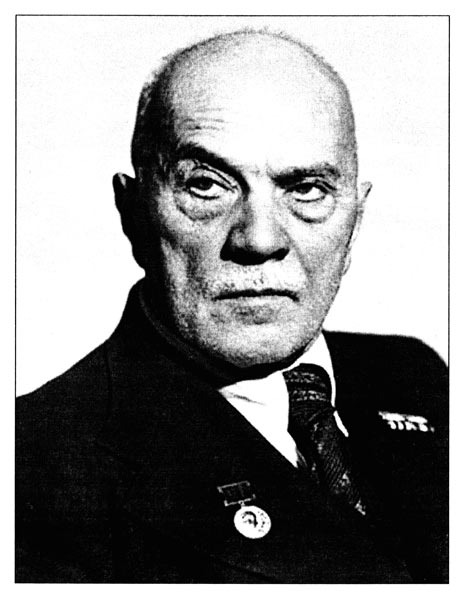
I do not claim to offer a serious study of the work of Valentin Alexandrovich Voytsekhovsky, but I consider it my duty to compile and write this essay in memory of a man, an architect, an Honoured Art Worker of the Moldavian SSR, a scholar and my professor, who devoted the best years of his life to the revival of architecture and construction in post-war Moldova.
On Computer “Engraving” “Russian Bookplate Journal”
One may pronounce the word “print,” meaning an impression, many times, but each time something different may be understood by this word. In the first case- it may be printing at a printing house, in a large print run, the so-called offset printing. In the second - it may be printer output, i.e. reproduction from a computer by means of a printer. In the third case - printing in a printmaking workshop, or in the artist’s creative studio.
Seven Meetings with Bogdesko
His work in the design of children’s literature, from textbooks to classical works by the greatest Russian, European and Moldavian authors, actively contributed to the introduction in Moldavia and Russia of progressive principles of illustration and the artistic construction of the book, book graphics and calligraphy.
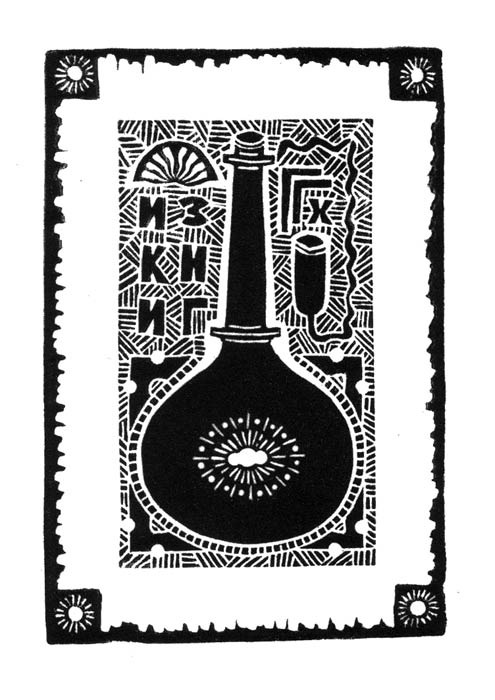
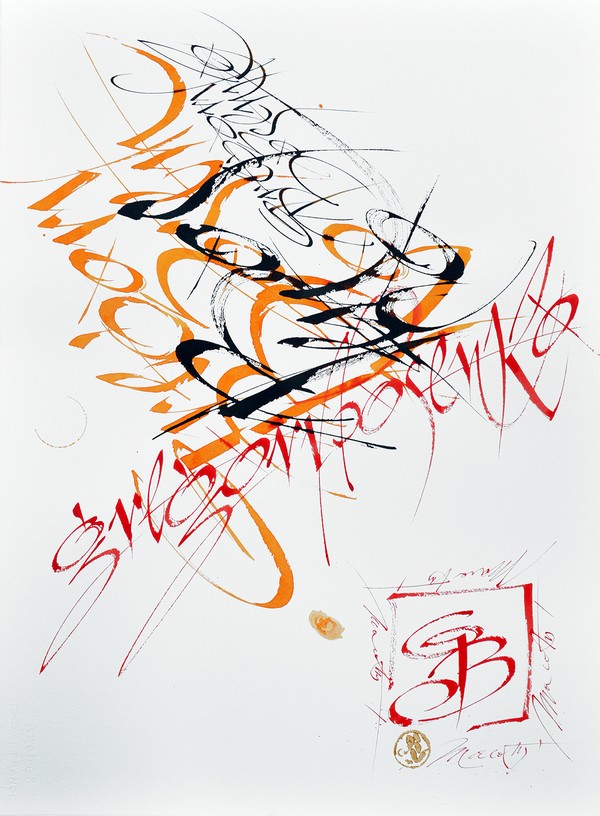
Typographic Bookplate
In modern calligraphy, pens as writing instruments continue to occupy one of the leading places, whether a reed pen, a metal nib, or a wild bird’s feather. The fascinating untouched surface of the sheet and the incomparable sensation of the pen touching paper continue to provide an impulse for creativity. Artists continue to search for new methods of execution and new principles of composition in the calligraphic opus. Modern calligraphy uses computer technologies without, in practice, displacing the broad-edged pen. Today brushes, ink, and paints coexist freely with the computer.
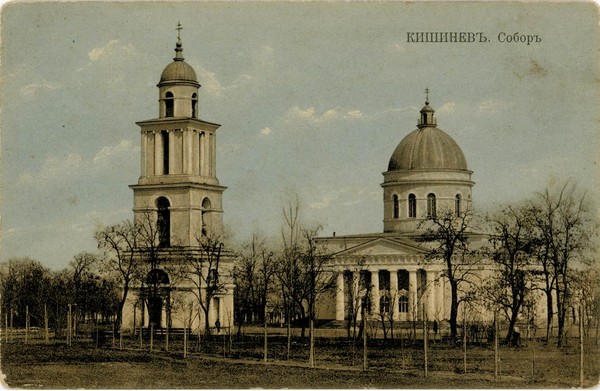
The “Chișinău” Postcard
The postcard... Is it not a reflection of the life of people, of a country, of an era? Is it not part of the general artistic culture? Is its right to be an element of material and historical culture recognized, arising in response to the needs of the day and participating in everyday necessities? What role can be assigned to this small form in education, promotion and the cultivation of artistic taste?
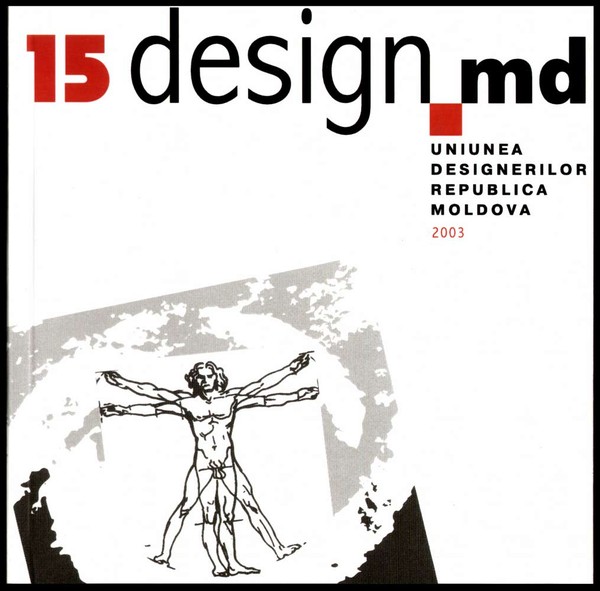
15 Years of the Designers’ Union
Fifteen years uniting professionals and enthusiasts in the field of design through creative work. This period brought many upheavals and changes, but we endured them, remaining faithful to our creative ideals and professional friendship.

Press Publications

Y. Tumanean. My Encounters
Together we went for a walk around the city of Chișinău, asking each other various questions and listening closely to the answers. The final phase of our excursion was an invitation to collaborate at the Chișinăugorproekt Design Institute, headed by Y. Tumanean. At that time, a cohort of interesting, talented architects worked there, and a new creative studio, “KM 7,” was due to open.
Makovey - Calligraphy
A calligrapher - a person who works with letter images - must be able to read very well, to read deeply and to express himself through a distinctive script. When one looks closely at the calligraphic works of Alexander Makovey, one feels masculine energy and force. And it is not a matter of plastic solutions, nor of mastering new compositional methods for constructing a calligraphic opus, but of the perception of an artist-calligrapher who is steeped in and breathes lettering. And no matter how he thinks or writes, he is nevertheless reflected in his entirety in his artistic writing, in his attitude toward life, toward himself, toward the grapheme. He cannot hide from his temperament, from his theme, from his aesthetics.
Bogdesko. One of the Last of the Mohicans - 2013
Born in 1923 in a Moldavian village, as a ten-year-old boy he learned the fundamentals of the Russian language in a settlement for exiles in the Kirov Region. In those same parts, he became an artist, graduating from the Kirov Art School, to which he walked 170 kilometers in bast shoes in order to enroll...
Twenty Out of Twenty-Five (Memories of the Creation and Development of the Union of Designers of Moldova)
Twenty-five years have passed since the creation of the Union of Designers of Moldavia. During this time, the state of the USSR, which created this creative Union, managed to disappear. The century that marked the birth of such a truly important profession as that of the “designer” has passed; with it, we also lost many of our colleagues who stood at the origins of Soviet, republican, and post-Soviet design. However, the foundations they laid for the edifice of “design” proved sound and correct. Modern man worships design in all its manifestations: fashion, interiors, automobiles, etc. Today, it is not the visual arts, cinema, or television that reign supreme; rather, design is “the most important of all the arts.” It lives in time and space: it has taken possession of architecture, penetrated theater and literature, and entered the economy and everyday communication. This is no longer the former artistic engineering; it is an attitude toward modern life. Design is the brand of the age. Design is a phenomenon of contemporary culture, a sign of movement and transformation.

Ex Libris Museum: 25 Years of Oblivion
One of the significant dates in my biography is February 10. Twenty-five years ago, on that day, the first ex libris museum in the former Soviet Union was born in Chișinău. Recently, while sorting through papers related to this event, I thought with poignant regret that a major and necessary undertaking, which had begun so well, unfortunately did not develop any further.
A Vacant Place Never Stays Empty
At that time, it had 10 squares. They usually arose at the intersections of streets and roads at the entrances to the city. They were used mainly for trade. The largest squares in the city were considered to be: “Old Square” (the most ancient, situated up the hillside from the crossing over the Bîc River and from Mazarache Hill-today G. Vieru Boulevard); “Red Rows” (a square with a merchants’ courtyard on the present-day territory of the Central Market); “Cattle-Driving” Square (later Ciuflea Square); “Hay” Square (the area of the Republican Stadium); “German” Square (today the Dinamo Stadium); “Railway Station” Square; and others.
Architecture in the Bookplate GB
Beginning approximately in the 1960s, with the development of book production, interest in the bookplate awakened everywhere. Bibliophiles and artists increasingly began to realize their profound involvement in the diversity of culture. In essence, during the Thaw, the younger generation rediscovered “its own culture,” art and literature. There arose a need to classify, preserve and mark private libraries. The bookplate was revived.
L. Dubinovsky - 2010
In my life, I had the opportunity not only to communicate with a great sculptor (which I can say without exaggeration), but also to collaborate with him. In 1976, I was working on project documentation for the landscaping of the grounds of the Administrative Building of the Central Committee of the Communist Party of Moldavia. The project also included the design of a granite pedestal for a two-figure composition dedicated to the founders of scientific communism, K. Marx and F. Engels. L. I. Dubinovsky worked on realizing the concept with his characteristic energy. The urban-planning situation was quite complicated, and the maestro developed more and more new versions, coordinating them with the “client” - the First Secretary of the Central Committee of the Communist Party of Moldavia. All the versions were interesting and could have been successfully implemented, but the sculptor was seeking a non-traditional solution. The task was further complicated by the fact that these two men (K. Marx and F. Engels) differed greatly in height and significance.
In Memory of Architect David Palatnik
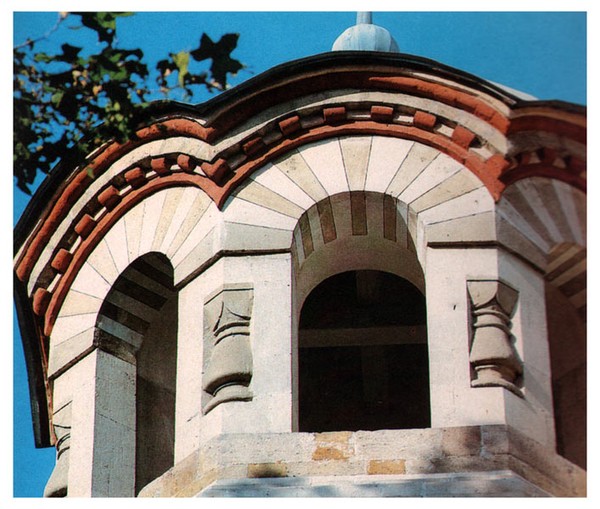
The architect was born in the city of Balta into the family of a stonemason. In 1932 he graduated from the Odessa Construction Technical School; in 1939, from the Faculty of Architecture of the Odessa Institute of Civil and Municipal Engineering. From 1940 he worked at Dorproekt, where he gained extensive practical design experience. During this period of his activity, the architect’s attention to the use of the architectural heritage and to the creative application of characteristic elements of vernacular architecture became evident. He used local building materials extensively and professionally: stone wall and facing materials, natural wood, and tiles. He made use of local traditions in material processing and the application of color.
In Memory of Architect V. Smirnov
Viktor Fyodorovich Smirnov was an Honored Artist of the Moldavian SSR, Candidate of Architecture, associate professor, and head of the Department of Architectural Design and Urban Planning at the Chișinău Polytechnic Institute /now the Technical University/.
Shussev. Our Historical Heritage Is Irretrievably Disappearing
In May, it will be one hundred years since the death of our fellow countryman, academician of architecture Alexey Viktorovich Shussev. The great architect realized his first and last projects in Chișinău. These were the Karchevsky family’s summer house in the Valley of Roses-today a residential building, 1897-and the pedestal of the monument to V. I. Lenin by sculptor S. Merkurov, 1949 (dismantled).
A. Bernardazzi - 2007
Today, walking along the old streets of Chișinău, it is difficult to imagine that the beautiful buildings and structures-undoubtedly bearing the imprint of the finest examples of world architecture-were built in a provincial town on the outskirts of the Russian Empire. It is difficult to imagine that these structures appeared on poor, unpaved streets, without greenery and without lighting at night. Much credit for this belongs to the outstanding architect, Honorary Citizen of the city of Chișinău, and public figure Alexander Iosifovich Bernardazzi.
In Memory of Architect A. Ambartsumyan - 2007
I had the opportunity to know Agasi Yeremovich Ambartsumyan for more than thirty years. Our first acquaintance took place in 1965, when I was completing practical training at the Moldgiprostroy design institute. At that time, the institute was located in the center of Chișinău, on A. Pushkin Street and Ștefan cel Mare Boulevard. I met this architect within the walls of the design organization and, owing to my youth, did not at all realize the significance of this master architect. Only eleven years later did I have the opportunity to work with Agasi Yeremovich.
In Memory of Architect A. Kolotovkin - 2003
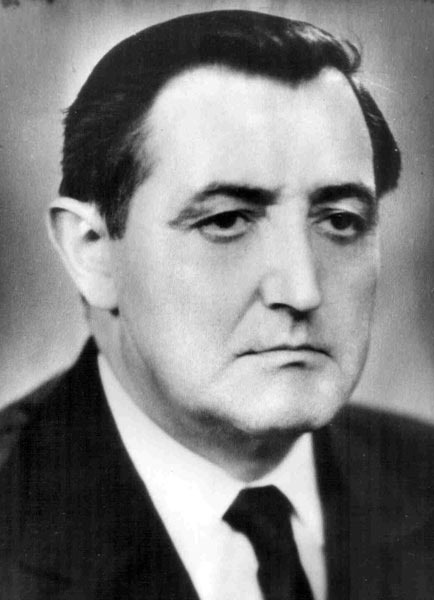
On 22 September 2003, Anatoly Vasilyevich Kolotovkin, Honored Architect of the Moldavian SSR, passed away. /Born 3 August 1928 in Konotop, Sumy Region./ After graduating from the Department of Architecture of the Lviv Polytechnic Institute, he was assigned to Chișinău. From 1953, he worked in Chișinău and designed a number of projects. From 1958, he was deputy chief architect of Chișinău. From 1964 to 1970, he was chief architect of Chișinău. From 1974 to 1992, he was director of the Molgiprostroy State Design Institute.

Publications about G. Bosenko

Brief Introduction - 1979
Grigory Bosenko’s works have been exhibited at the All-Union Bookplate Exhibition (1972, Lviv); the International Exhibition “Book-75” (1975, Moscow); the Republican Exhibition of Visual Arts “The Country’s Youth” (1976, Chisinau); the All-Union Exhibition of Visual Arts “The Country’s Youth” (1976, Moscow); the First Republican Bookplate Exhibition (1976–1977, Chisinau); and the International Exhibition-Competition (1978, Lugano, Switzerland).
Type as a Sign. Bosenko 2006
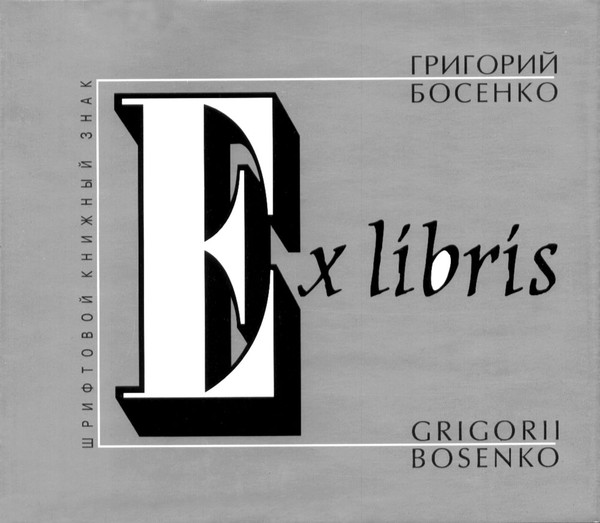
The typographic, handwritten ex libris-the prototype of narrative-compositional bookplates-has a centuries-old history. Books in those times were of exceptional value. The owners of libraries-monasteries, clergy, and feudal lords-marked their collections with a sign, thereby protecting them from thieves. Scribes made a written mark at the beginning of a book indicating that it belonged to a particular library or person. Later, books began to be adorned with a drawn vignette intertwined with initials.
Bookplate. Bosenko 2004
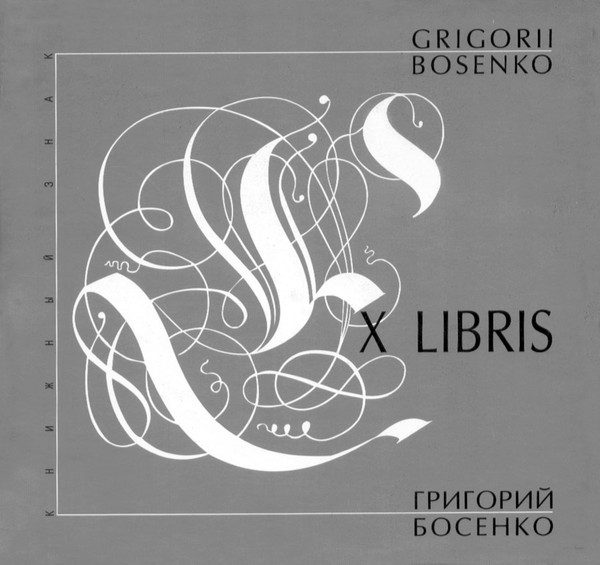
The bookplate, or ex libris (translated from Latin as “from books”), has its origins in the culture of Ancient Egypt, in the time of Pharaoh Amenhotep (fourteenth century BCE), when faience plaques bearing the ruler’s personal seal began to be attached to papyrus scrolls. The development of the ex libris in Western Europe was greatly fostered by the interest shown in it by such celebrated masters as Albrecht Dürer, Lucas Cranach, and Hans Holbein throughout the eighteenth to twentieth centuries. Russian artists also made a major contribution to this graphic-art genre.
Greeting Engraving GB - 2001
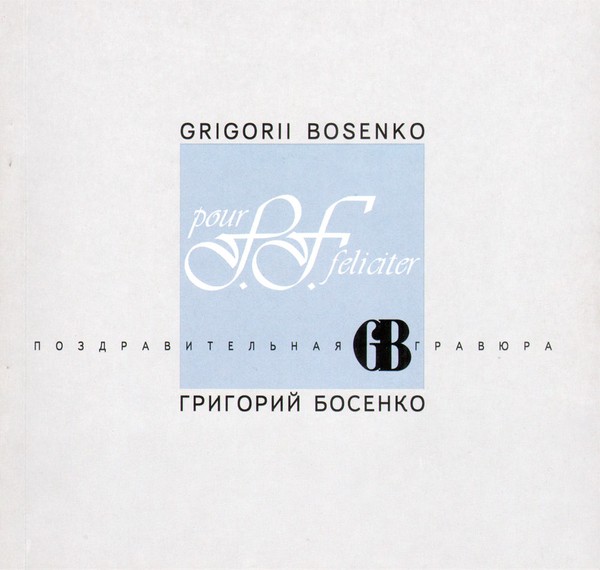
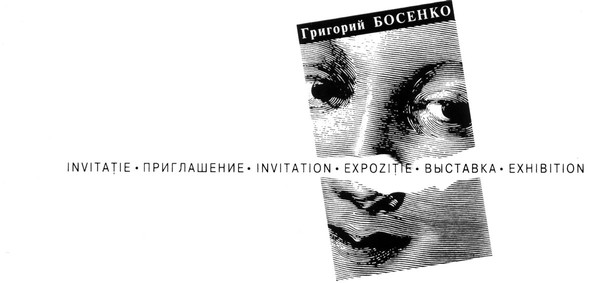
One of the directions of Grigory Bosenko’s multifaceted creative activity is the New Year greeting engraving, “Pour féliciter,” a personal genre of small-scale graphic art, which translated from French means congratulations on an occasion. The artist’s enthusiasm for miniature graphic art, and above all for the ex libris, inevitably led him to developments and explorations in this intimate and engaging direction of personal graphic art. Participating in the most prestigious international exhibitions and competitions of small-format graphic art, G. Bosenko corresponded and exchanged works with many leading European masters and friends in the art of engraving.
Greeting Engraving GB - 2001
Belonging to the intellectual artists also dictates the approach, direction, and orderliness of stylistic and technical means. Signs and motifs, methods of constructing the plot and composition change, but the atmosphere and mystery remain. The precision of the chosen means of construction determines a composition in which adding or removing any element means destroying its semantic and artistic structure.
Architecture is my first love
“Architecture is my first love,” the artist himself admits. He graduated from the Faculty of Architecture of the Chișinău Polytechnic Institute. He designed numerous public buildings; the most interesting of them were the project for a children’s animation studio and the “International House of Republican and Union Tasting.” Both, unfortunately, were never realized, since the client at that time was the republic’s top official, who was soon removed from office. However, at the architectural-design stage, these works and the interiors for the Central Committee building were awarded a diploma in the All-Union competition of projects by young architects.
25 Years of Creative Work GB - 1996
As human society and its culture develop, aesthetics also change-that is, the sensory perception of the surrounding world. Along with general progress, the range of processes and phenomena in art that become the object of a new aesthetics, the object of a new culture and new concepts, expands. There are certain relationships between art in practice and theoretical trends (leaving aside the influence of ideology).
25 Years of Creative Work GB - 1996
In the process of the development of human society and its culture, aesthetics-that is, the sensory perception of the surrounding world-also changes. Along with overall progress, the range of processes and phenomena in art that become objects of a new aesthetics, a new culture, and new concepts expands. Certain interrelationships exist between art in practice and theoretical tendencies (setting aside the influence of ideology). A process of evolutionary change and the emergence of a new aesthetics, a new art, is under way.
25 Years of Creative Work GB Esina - 1996
However many different meanings these words may encompass, it is precisely with them that one should begin: Grigory Bosenko is a contemporary artist. Intuition, erudition, and experience enable him not only to trace the subtlest fluctuations in the present-day system of worldviews, but also to exist within it as a creator in his own right. Bosenko’s creative manner, images, and ideas enter naturally into the range of the era’s artistic values, since they fully correspond to its tendencies.
Barashkova on GB - 1990
Bosenko gratefully remembers his teachers: first N. T. Samborsky, an excellent teacher who introduced him to book graphics; then V. A. Voytsekhovsky, a scholar and talented architect who remained an example of perseverance, erudition, and uncompromising service to architecture; and finally the architect Yu. B. Tumanyan, who devotes equal attention to the practice and theory of visual art and architecture.
Barashkova on GB - 1986
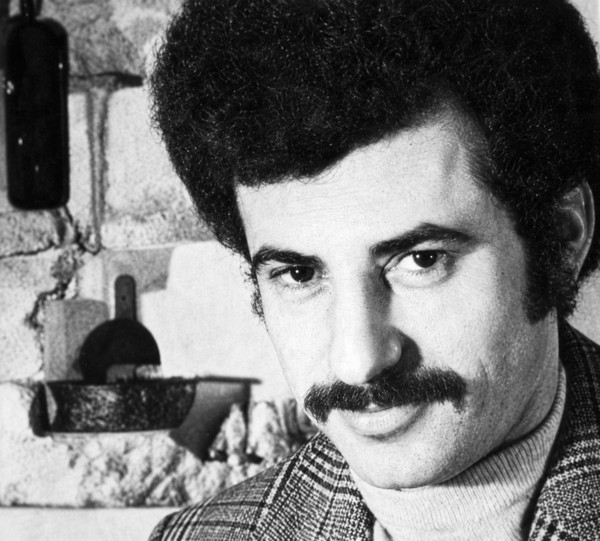
Grigory Nikolayevich Bosenko was born in 1947 in the town of Kiliya, Odesa Region. In 1972 he graduated from the architectural department of the S. Lazo Chisinau Polytechnic Institute. In ten years of work in the field of architecture, G. Bosenko managed to accomplish much, and the result of this labour was that in 1977 he was awarded the title of laureate of the All-Union Review-Competition of Young Architects’ Work for the project of the building of the Yalsveny Scientific and Production Association Institute and the design of the interiors of the administrative building of the Central Committee of the Communist Party of Moldova.
Voluntary Society of Book Lovers of the Moldavian SSR - 1981
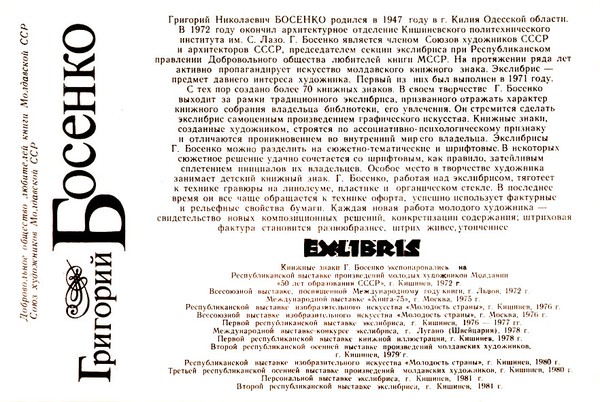
In 1972 he graduated from the architectural department of the S. Lazo Chisinau Polytechnic Institute. G. Bosenko is a member of the USSR Union of Artists and the USSR Union of Architects, and chairman of the bookplate section of the republican board of the Voluntary Society of Book Lovers of the Moldavian SSR. For a number of years he has actively promoted the art of the Moldavian bookplate. The bookplate has long been an object of the artist’s interest. His first one was executed in 1971.