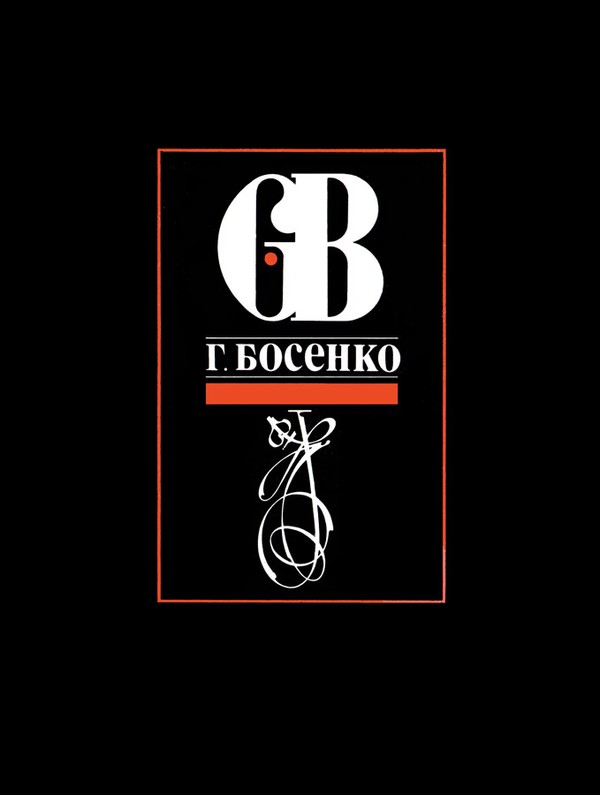
1990. Album “GB - G. Bosenko,” Chisinau, Timpul Publishing House
Grigory Nikolayevich Bosenko is known to art lovers as a graphic artist working in the fields of bookplates, posters, book illustration, and design.
He began as an architect: first he graduated from the architectural department of a construction technical college and then, in 1972, from the S. Lazo Chisinau Polytechnic Institute. The artist’s development passed through several stages associated with people or events that played a certain role in the evolution of his work.
Bosenko gratefully remembers his teachers: first N. T. Samborsky, an excellent teacher who introduced him to book graphics; then V. A. Voytsekhovsky, a scholar and talented architect who remained an example of perseverance, erudition, and uncompromising service to architecture; and finally the architect Yu. B. Tumanyan, who devotes equal attention to the practice and theory of visual art and architecture.
His architectural education and particular attachment to architecture are evident both in Bosenko’s graphics and in his design works of recent years.
But the reverse connection can also be seen: his architectural projects from his student years were created as a kind of graphic sheets, with the most delicate elaboration of composition, background, and detail.
The beginning of his work in graphic art was marked by his turn to the poster. Series of posters devoted to environmental protection, the circus, Shakespeare’s drama, and finally typographic posters were an unquestionable success for the artist. He joined the USSR Union of Artists as a poster artist.
At almost the same time, Bosenko turned to the small forms of graphic art, which by the 1980s had become the defining direction of his artistic activity.
The short phrase “Ex libris,” which formerly denoted only a book’s ownership, had by the end of our century become such a capacious concept that the bookplate had developed into an independent genre of graphic art. These graphic miniatures afford a special freedom of imagination and an opportunity to reveal the artist’s individual manner; they do not constrain the author’s interpretation of events and characters within the bounds of “official art.” Perhaps this is why bookplates and PF became the field in which the artist has been actively working for almost twenty years.
For him, the small forms of graphic art are not only an object of creativity but also of promotion: over these years he has written articles and published catalogues and booklets on the republic’s bookplates. Bosenko donated his collection of bookplates to Chisinau, and it became the foundation of the country’s first bookplate museum, which opened in 1988.
This collection did not take shape all at once: in exchange for G. N. Bosenko’s bookplates, graphic artists from other republics and countries sent him their works. And now thousands of viewers can become acquainted with this most interesting collection, which includes works by S. Telingater, G. Kravtsov, A. Kalashnikov, V. Toots, P. Upitis, H. Paalasmaa, A. Kot, G. Taga...
Over almost two decades of creative work, Bosenko’s oeuvre has travelled a long path of development-from ordinary burin engravings to the most delicate, intricately complex etchings; from the simple bookplate to complex, capacious graphic compositions-opuses. Throughout these years the artist has developed his own style; his miniatures have their own face, character, and rhythm of inner life. The master’s attachment to architecture is also evident in his bookplates: in their construction, tectonics, structure, in the logic by which an idea is carried out, and even in the artistic fusion of metaphors.
The forms of the miniatures are made up of many components, often found earlier and developed in subsequent works or even in an entire semantic, thematic, or artistic group of opuses.
The artist always strives to create an integral image, interpreting, very individually and at times with humour, the character of the person to whom the bookplate is dedicated. It is precisely thanks to this that, in our view, the remarkable “portraits” of E. Stasyulis, I. Kyrmu, Yu. Khorovsky, A. Samborsky, R. Bosenko, and others have appeared.
A figurative principle is also inherent in the artist’s typographic bookplates. Bosenko is known as an excellent calligrapher. His typographic miniatures develop from the simplest compositions, in which the influence of V. Toots’s school can be felt, to the thoroughly individual discoveries of recent years, which are not merely a virtuously executed arrangement of letters, but living lines that, under the artist’s hand, turn into metaphors, types, and allegories.
Something similar can be seen in the bookplates of Klaus Redel (1983), where the plasticity of type creates calligrams of the sea; in the “Bosenko Book Collection” mark, where the intricate interlacing of letters recalls the motif of a Ukrainian song; and in E. Barashkov’s 1977 bookplate, in which spectacles composed of a strict ellipse with restrained lettering and a free oval with an unrestrained flourish speak of two spheres of activity, and perhaps of the complexity of a person’s character.
One of the characteristic features of the best works is the use of contrast. The entire opus is built upon the juxtaposition of polar elements, rhythms, textures, tones, or images. And such techniques are so diverse and varied in character that they form a whole gallery of discoveries. Thus, in some engravings the effect is achieved through the comparison of patches differing in luminosity (as in the bookplates of S. Bul and Oculist), or of line and patch (R. Akulova’s 1980 bookplate and the mark for V. A. Voytsekhovsky), fine interlacing of strokes and a bold, clearly defined inscription (the bookplate for R. Bosenko’s needlework books and K. Redel’s 1985 bookplate), or symbols (for example, the gallows and the swing in the bookplate for K. Redel, 1983, and Lykhmus).
The list of such techniques could be continued.
The artist is constantly seeking and finding something new. This not only enriches his work but creates an inimitable authorial handwriting that distinguishes him within the immense diversity of contemporary graphic art.
A philosophical understanding of life, time, and space is another distinctive feature of G. Bosenko’s artistic language. The allegory of life-the gallows and the swing, joy and despair, sailing ships as a symbol of its eternal movement-recurs more than once in his opuses.
In Bosenko’s graphic miniatures, a performance continues for many years-a dialogue between the viewer and the artist, a performance that unfolds over time, a dialogue that resounds long in the memory. Like the character in the bookplate for Vanden Briele, the artist seeks to penetrate the mystery of earthly existence, to look behind the scenes of life’s theatre.
The art of masters from different eras-from the Renaissance to our century-has always attracted the artist. Turning to the work of Cranach, Dürer, and de Chirico, he seeks to reconsider their perception of the world and to introduce particles of their precious experience into his own works.
For several years now Bosenko has been creating opuses on the theme of Albrecht Dürer’s art. The first bookplates were based more on typographic explorations of Renaissance roman type. The 1988 marks differ in character: one plays upon the theme of Dürer’s famous engraving “Knight, Death and the Devil” and is built on an organic union of a typographic letter and allegorical characters, while another creates a multifaceted image of the time of the German Reformation. Architecture is always the face of an epoch; and, depicting here buildings of different styles-from medieval castles to Tatlin’s Constructivist tower-Bosenko unites the architecture of all times through the common idea of shaping the human habitat. The complex interweaving of the plot is prompted here by a definite thematic orientation: the bookplate was created for the exhibition “Landscape and Architecture.” The artist has whole series of engravings devoted to theatre, music, and architecture, which is a consequence of his participation in all-Union and international thematic exhibitions in the Soviet Union-in Moscow, Tallinn, Riga, Vilnius, Minsk-as well as in the GDR, the FRG, Hungary, Yugoslavia, France, Belgium, Switzerland...
Bosenko’s opuses often include depictions of widely varying, sometimes very unusual architectural structures. The artist’s imagination combines an accumulation of architectural structures and a ship listing under the weight of these constructions; in another work, an elegant portal supports the wings of an aeroplane. Various events take place against the backdrop of architectural scenery, and the characters of his works live there.
Even the inexorable course of time is viewed by the artist through the prism of architecture. In his engravings, time divides a city into epochs with invisible facets or, turning into a black sphere, destroys ancient buildings.
The characters of the artist’s children’s bookplates live according to the laws of their own magical time. G. Bosenko has a subtle perception of the world of children; therefore, such bookplates are imbued with a profound insight into their joys and dreams. A lace collar of a little mouse-girl (Lyubochka Bosenko’s bookplate) seems woven from tiny clock-rings as she is transported to the land of dreams hidden in a pillow. Across a little bridge cast through time and space, gnomes lead the boy Pavlik after them; mysterious melodies summon him to the house where a fairy tale lives, in Kolyenka Bosenko’s bookplate.
Usually, all elements of the artist’s engravings carry a specific signifying and semantic weight, and even a seemingly insignificant detail helps to express the character of the subject more fully.
Bosenko also has formal and technical explorations in which compositional, technical, and textural searches play the decisive role. Thus, the artist created his “springs”-typographic marks in which tension increases from letter to letter, and calm lines gradually become rounded, unfold, “exploding” at the end in a virtuoso flourish.
Experiments in the development of background sometimes create unexpected effects: thus, in zincographs on the theme of music, the colour transitions can be interpreted as modulations of sound.
The search for painterliness in a single colour by means of tone leads to the astonishing richness of the tonal range in the opuses of recent years.
The interpretation of a heap of “junk” gave a special resonance to a bookplate on a Chekhov theme; in E. Yepur’s mark, this heap is transformed into ears of wheat and creates a successful background for hands holding a sickle and hammer.
A special group of miniatures in which Bosenko also conducts graphic explorations is pour féliciter (abbreviated PF), the so-called greeting graphics. The artist approaches the creation of such works in his own way, without striving to tie a sheet to the symbolism of a particular year. For him, PF is a kind of carnival costume that can be imagined and put on only on New Year’s Eve. The complex juxtaposition of metaphors, the philosophical subtext, and the most delicate technique in the best sheets create profound and interesting images. Here, too, the artist uses his favourite motifs of “junk,” from which he assembles now a sailing vessel, now a fish, now a windmill, symbolising the steady movement of architectural scenery.
In general, one must note a certain unity of the thematic and narrative range, the system of metaphors and allegories, as well as their embodiment and interpretation in the works of G. Bosenko, which creates a sufficiently integral image of his oeuvre.
The notions of constructiveness, logic, contrast, imagery, philosophical depth, and technical “finish” apply not only to bookplates and PFs, but also to the artist’s posters, his design projects, and his best works in book graphics.
The artist continues to perfect himself, his engravings become more complex, and, it seems, art lovers will yet see many interesting works by G. N. Bosenko.