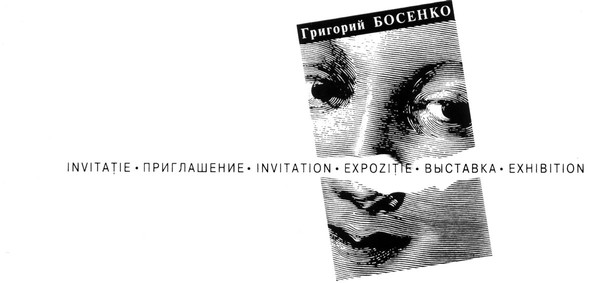
GRIGORY BOSENKO
25 Years of Creative Work
However many different meanings these words may encompass, it is precisely with them that one should begin: Grigory Bosenko is a contemporary artist. Intuition, erudition, and experience enable him not only to trace the subtlest fluctuations in the present-day system of worldviews, but also to exist within it as a creator in his own right. Bosenko’s creative manner, images, and ideas enter naturally into the range of the era’s artistic values, since they fully correspond to its tendencies.
Let us begin with the fact that the stimulus for the constant evolution of Bosenko’s creative work is his striving for technical perfection, with development proceeding as swiftly as the pace of the universal movement that has swept through the twentieth century permits. Only a few years ago, in resolving formal contradictions, the artist reached a level beyond which it was difficult to imagine anything new: the entire spectrum of visual contrasts, from linear and chromatic to textural and even contrasts of scale, had been traversed. Moreover, it is characteristic that each new formal period in Bosenko’s creative work originated in engraving and found its multivariant culmination in easel graphic art (not to mention its countless echoes in the field of graphic design). It was evident that, within the pace that had been set, new solutions-determined partly by changes in technology and partly by the artist’s intellectual explorations-were bound to exhaust themselves. Further movement, having reached a dead end, would have proceeded along the same trajectory, even if at a higher level. However, having fully established himself as a master of graphic form, Bosenko discovered a new path-the path accessible only to those who find satisfaction not so much in their own creations as in the creative process itself. And this is a path traced and mastered by artists only in the middle of our century. It passes through the territory of subconscious symbolism, which is expressed in the spiritual and intellectual intensity of form.
Grigory Bosenko found a course parallel to the one that writers had begun to use even before artists: so-called supra- and infrarealism. Having once decided to submit to the involuntary movements of his hand and to his imagination, Bosenko brought the smallest and most primitive details to the foreground, endowing them with monumentality. The creator’s classical aristocratic refinement, which compels the artist to conceal perfected forms one behind another, acquired a new quality in Bosenko’s work: he began to display only part of a form, inviting the viewer to find complete meaning and perfection even within that part. The process marking a new formal era in Bosenko’s creative work began this time in the field of graphic art most suitable for it-calligraphy; for what, if not the grapheme of a letter, so intimately familiar to everyone, could enable a true experimenter and poet of graphic art to reveal every possible metamorphosis of lines that had seemingly become forever fixed in our consciousness? Who could have imagined that there is not only the line of a form, but also the form of a line (the “Linia T” logo), or that several stylized letters could not only reveal, but also describe in the most exhaustive way, aspects of the creative work of Bach and Blok that were previously unknown to anyone... The world is now being comprehended in the most unexpected directions, and the artistic method appears to be the most effective and deeply penetrating. Bosenko is already using these new solutions in the field of engraving. As for easel graphic art, it is developing along a different path.
A distinctive feature of contemporary culture is that every phenomenon is customarily considered, first and foremost, in its reflection through cultural studies. The tradition of thought has weighed down our thinking. Art has been weakened by an inevitable derivativeness, which the element of individuality does not always help to overcome. In this case, novelty may be achieved, for example, by consciously playing upon and intensifying derivativeness. Thus, owing to the familiar skepticism inherent in our civilization, we repeat with different intonations the same word, which long ago lost its magic, and at a certain point we once again sense its sacredness. Bosenko uses approximately this method in creating his graphic sheets: by repeating the principal motif in numerous variations and combinations, he achieves an effect of clarity and detachment simultaneously. Playing with traditions and within tradition renews traditions themselves rather than eliminating them. The series of works “Portrait of My Attitude” is an attempt to think through the images of another artist, compelling the original to exist in a different world and to combine what had not had time to be combined, or what fundamentally could not have been combined, in the primary source. This, too, is one way of comprehending the world-the world of art this time. Creative work amid creative work. This is precisely the derivativeness that became absolutely original through its recognition as an archetypal and cultural-studies method. Here, it seems, Bosenko is even closer to the central, principal direction of contemporary explorations, for sincerity is always the newest quality in art.