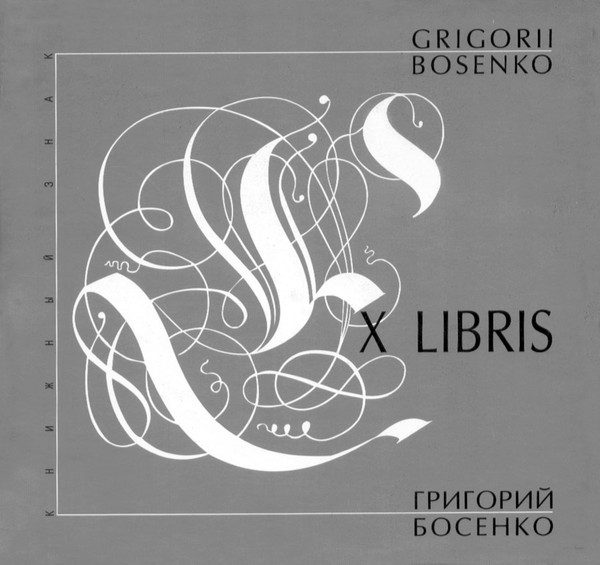
The bookplate, or ex libris (translated from Latin as “from books”), has its origins in the culture of Ancient Egypt, in the time of Pharaoh Amenhotep (fourteenth century BCE), when faience plaques bearing the ruler’s personal seal began to be attached to papyrus scrolls. The development of the ex libris in Western Europe was greatly fostered by the interest shown in it by such celebrated masters as Albrecht Dürer, Lucas Cranach, and Hans Holbein throughout the eighteenth to twentieth centuries. Russian artists also made a major contribution to this graphic-art genre. The 1970s to 1990s were highly productive decades for the bookplate. Whereas in its classical form the ex libris was a small printed label pasted by a library owner into a book, necessarily bearing the bibliophile’s first and last name as well as a drawing revealing his pursuits and interests, in the last third of the previous century the concept of the “bookplate” underwent a significant transformation: the ex libris became an object of visual art, developing actively as miniature aphoristic graphic art; it became an object for prestigious international themed exhibition-competitions and an item for collecting. It ceased to be an attribute of library collections, whether private or public. Enriched with new symbolism, bookplates are used to mark music collections-sheet music, records, and cassettes: ex musicis. The existence of the artistic ex libris is one of the indicators of the development of national culture. The aspiration of educated and cultured people to give their assemblies and collections a personal character makes miniature artists sought after, successfully resolving the task set before them. From his days as a student, the art of the ex libris has accompanied the author of the miniatures presented here, reflecting not only a distinctive vision but also predetermining discoveries for the adjacent disciplines in which he works. The chronology of bookplates reveals the artist’s creative world and the distinctive rhythm of the development of his personality. The ex libris becomes a means of expressing his attitude toward a particular person, his closeness to the owner of the engraving, and his penetration into the subject matter through the concise language of graphic art-the spiritual world and philosophy of life. The author strives for complete self-expression in all compositional themes and varieties of graphic mastery, without forgetting the requirements imposed on the ex libris: correlation with the personality of the bibliophile, the combination of type and image, and observance of specific dimensions. They may be resolved in different ways: symbolism, allegory, antithesis, analogy, grotesque, a humorous or direct statement.
A decisive turn in the development of his work occurred after a series of participations in prestigious European ex libris exhibitions. With the use of a microscope, engraving rose to a new stage and became an object to which he devotes special attention. The palette of techniques, subjects, and motifs expanded. The traditional notion of the metal plate (matrix) is being destroyed. Tone becomes the object of inspiration. The artist deliberately employs one and the same technique, enriching it with the past achievements of the technical possibilities of etching. Above all, this is a more meaningful fascination with line and stroke, and the mastery of new artistic techniques. During this period, the metaphorical motif becomes the principal creative impulse and the strongest feature of multifaceted creative freedom. Elements of architecture, structure, and tectonics became a favorite theme in the ex libris throughout the entire period of its development in the artist’s work. The presence of all these elements introduces the viewer into an atmosphere of planar and spatial archetypes, demonstrating the author’s connection with an architectural education. The artist’s inclination toward the typographic ex libris is equally integral. He is fascinated by the possibilities of tools and artistic materials (the glide of the pen, the etched stroke, the texture of paper). The line-smooth or dynamic, capricious or elegant, fancifully curved (as in works created in the Art Nouveau style)-gives rise to associations with the image of the owner of the bookplate. For greater expressiveness, the author uses a black or tinted background of the “plate,” across which the line moves. The typographic ex libris remains a symbol of the relationship between artist and owner, a traditional dialogue between them. A calligraphic opus becomes a work of art only when it contains the author’s personal position, his mastery, erudition, and emotional attitude toward the owner of the bookplate. Intrigued by the genre’s symbolism, the viewer seeks in printed graphics an adequate, personal impression of the owner, a disclosure of the stated theme, and the creator’s vision. A subtle and delicate philosophical principle, an attempt to give a miniature work perfection and beauty, and an assessment of the creative handwriting enabled the author to bring small-format engraving to a new qualitative level. A bookplate made for contemporaries turns into a small-format graphic document of an era, reflecting the personalities of its time, the philosophy of the epoch, and the technical possibilities for executing the opus. In creating an ex libris, the author produces not merely a functional mark of ownership but a work that has the significance of a symbolic artistic dialogue between culture, personality, and time.