2009
“Russian Bookplate Journal,” Issue 10, pp. 42-46
Moscow. Published by “RAE and MSK”
The Spiritual Experience of the Artist Nikitin
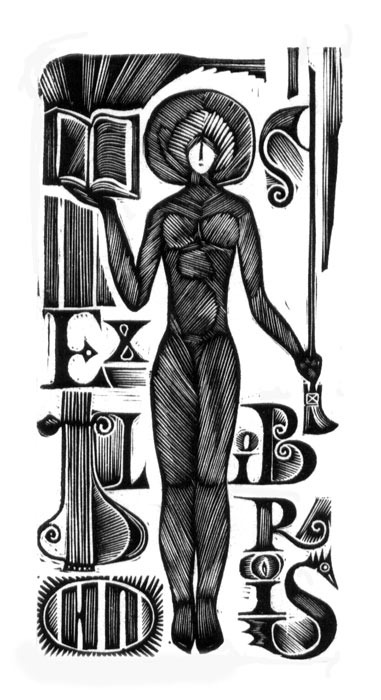
Leonid Stepanovich Nikitin was born in 1939 in the city of Znamianka, Kirovohrad Region. He graduated from the Ivan Fedorov Lviv State Institute of Printing in 1967. A recognised master of the bookplate, he cut approximately one hundred bookplates distinguished by the filigree precision of their lines, the originality of their compositional solutions and their elegance.
His bookplates were exhibited at the International Exhibition of Book Graphics (1971, Leipzig, Germany); the All-Union Bookplate Exhibition (1972, Lviv, Ukraine); the international exhibition “Book-75” (1975, Moscow); the First Republican Exhibition (1976, Chișinău); and the international exhibition “Writers and Literature of Romania” (1992, Oradea, Romania). He has been a member of the Union of Artists of the USSR since 1976. He lives and works in Chișinău, Moldavia.
The fate of the Moldavian graphic artist Leonid Nikitin seemed remarkably simple and clear, as did that of many graduates of the period. After graduating from the Lviv Institute of Printing, he was assigned to Chișinău, where book graphics and printing were flourishing at that time. With his first works for a publishing house and in the fields of easel and small-format graphic art, he immediately asserted himself with confidence. He found his own path, graphic voice and intonation. Nikitin organically joined the broad current of young graphic art, the widespread enthusiasm for plastic, linocut and mixed techniques. Through these media, young graphic artists proclaimed concision in a strictly black-and-white manner and the energy of sharply cut forms and strokes, which conveyed a distinctive monumentality of reality and modernity.
The young artist Nikitin also contributed to the development of this movement. Finding himself in a youthful and romantic environment of exploration and innovation in graphic art and an atmosphere of healthy creative competition, he actively began to develop his potential. He received many publishing commissions to illustrate works by Moldavian authors and participated in many exhibitions. Many sought to obtain a bookplate executed by L. Nikitin. While maintaining the general style of the new movement, his works contained something special and unique.
The realisation of lived and emotional experience - his own rather than borrowed, contemplative and wandering - acquires particular value for the author. Hence the strengthening of the personal principle in Nikitin’s graphic art. What is developed is not so much the visual form of what has been seen as that which is experienced inwardly.
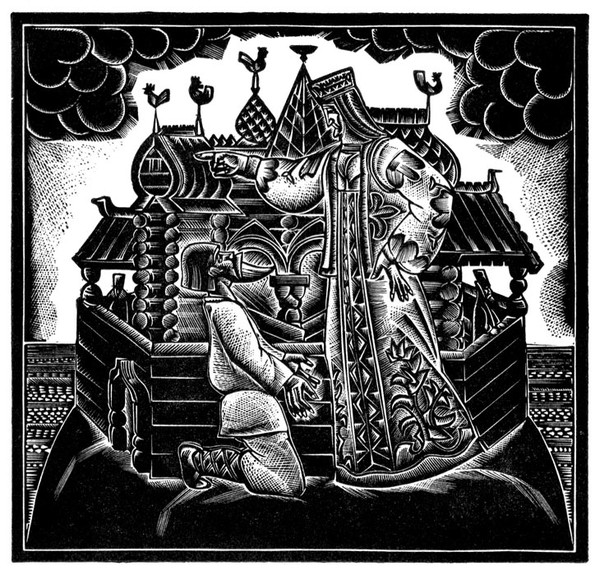
Leonid Nikitin’s finest works from the late 1960s and early 1970s are linocuts: “The Shepherd Boys,” “Old Orhei,” and the design of A. S. Pushkin’s books “The Winter Road” and “The Tale of the Fisherman and the Fish,” and G. N. Meniuc’s “Little Icarus.” He also designed a number of books in the “School Library” series: E. Bukov’s poem “My Country,” L. Deleanu’s poems “From Young to Old,” and N. Kostenko’s poem “Kin.” He created illustrations for P. Darie’s poems “Life as a Legend” and V. Maleva’s “Unfinished Diary.”
The illustrations for P. Darie’s poems, executed as linocuts, clearly gravitated towards social issues. They were characterised by a dramatisation of action. Elements of an open, almost poster-like dynamism of the image were combined with poetic imagery. The heroes of the engravings live, struggle and advance into the future, into an open world. There is something simple and compelling in the compositions.
The development of graphic art moved rapidly forward, broadening and deepening its course. Nevertheless, the beginning of the 1980s found the young artist in a state of dissatisfaction. He was no longer satisfied with what he had done before; his former techniques appeared shallow and unconvincing. The “direct” approach to the motif, image and genre proved inexpressive. By that time, the former stream of linocut production had noticeably subsided. A “white manner” emerged in linocut, if the “lino” technique of the 1960s may be described as “anthracite.” “Quiet graphic art” appeared, with increasingly complex techniques and graphic devices, refined feelings, subtlety and the emotional use of colour.
At that time and under those conditions, a return to drawing took place. The simple pencil or pastel became the subject of the easel sheet. A broad spectrum of contemporary themes and ideas led the artist towards self-realisation in etching. L. Nikitin did not remain apart from these explorations.
The artist tested all his explorations and graphic discoveries in small forms, in bookplates. All the bookplates of this period possess a clearly calibrated and predetermined figurative concept. One senses the convincing rationality of philosophical generalisations, a deliberate freedom and an abstract quality of feeling. Engraving technique and the act of execution appear as a fully fledged and, moreover, one of the most important components of the image. In the “bookplate” genre, the engraver feels free, spontaneous and technically assured.
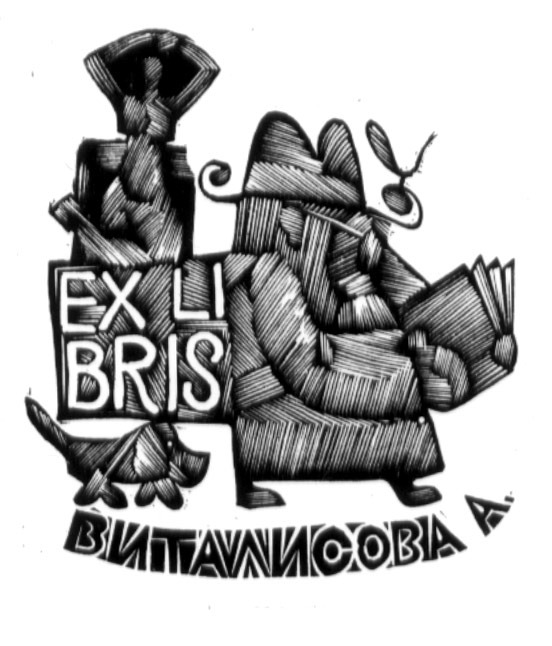
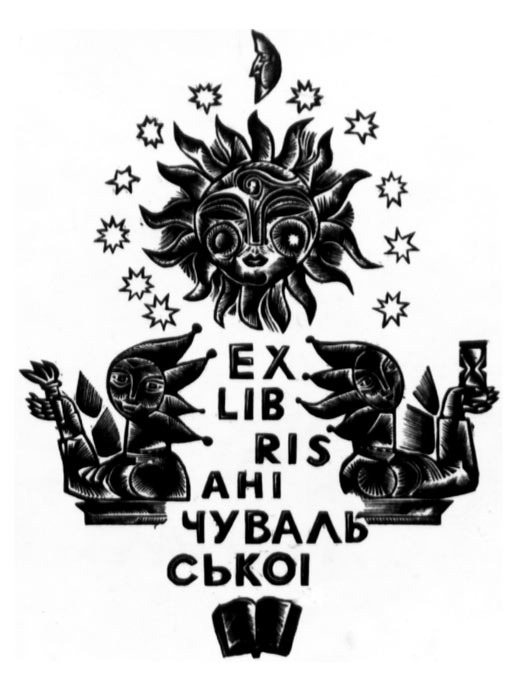
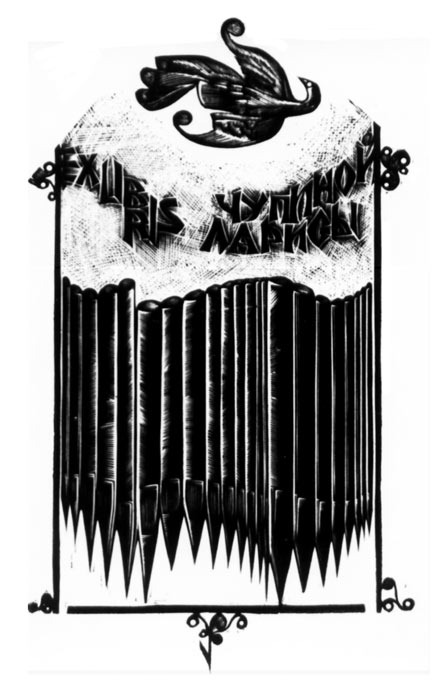
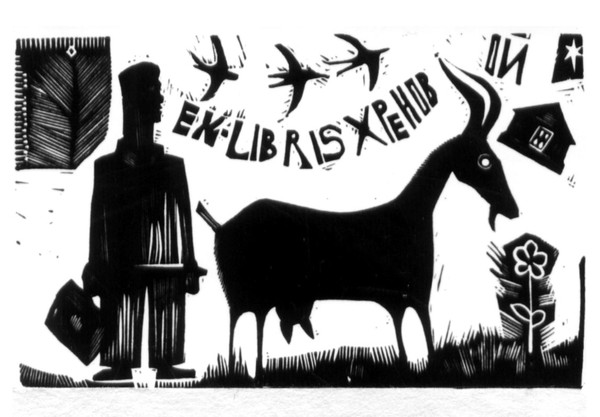
The bookplates of the 1970s and 1980s attract attention through their compositional novelty, distinctive treatment of the line, metaphorical multiplicity and originality. Among them are Khrenova’s bookplate, recognised at the exhibition in Leipzig in 1971, and the ex libris of Vitalisov, Larisa Chupina, Chuvalskaya, N. Kramarenko, etc.
When analysing and evaluating Leonid Nikitin’s book graphics, we inevitably recall the literary works that served as the artist’s figurative point of departure in his ascent into his own artistic worlds. These are, above all, “Stanisław Lem” and “the Strugatsky brothers.”
Among the visual arts, graphic art is the closest to literature. The narrative character of graphic sheets, the conventional nature of the means of artistic expression and metaphor intersect and intertwine. In illustration, the paths of representing the word, as well as those of graphic art, find their complete and diverse realisation. This specificity of graphic art is vividly manifested in L. Nikitin’s illustrations, especially in those created for works of contemporary Moldavian poetry. It was precisely in these works that the artist found his individual hand and original style, revealed the artistic structure of his art and formulated an independent creative concept. Poetry generated in Nikitin’s graphic art the metaphorical expression of ideas that forms the foundation of his artistic thought.
The subsequent years passed under the banner of the preceding 1970s. These were “embedded” images, graphic interpretations, and solid, technically accomplished engraving with an elevated intonation of line.
Yet L. Nikitin soon began to reconsider his creative path and did not deem it necessary to continue exploiting what had already been discovered. The artist entered a period of creative exploration. For several years, his works were not seen at exhibitions. One could only speculate about what was taking place in his creative laboratory. After some time, new graphic sheets appeared, not united into a series or cycle, but enriched by a new method in which the technique of printed monotype was experimentally combined with engraved textures. This enabled Leonid Nikitin to discover new plastically expressive compositions that united capacious images and symbols of time within a single genre.
The explorations in the bookplate during the 1980s may be attributed to an interpretation and understanding of the past, the present and probably the future. The graphic sheets consist of the same elements, but their expressiveness in literary or graphic spheres is filled with different images. Although the graphic artist seeks in his explorations and aspirations to affirm the beauty of nature and poetry, silence, desolation and emotional contemplation can be discerned in the miniatures.
As before, L. Nikitin works with a burin on linoleum and plastic, preferring the spontaneity and speed of the creative process to prolonged sketching. He is inclined to transfer the energy of impressions from life directly into the language of graphic art. The artist masterfully uses all the possibilities of this technique, simple only at first glance: the expressiveness of a freely flowing line, the richness of tonal hatching and the velvety quality of black. It is important to him that each bookplate should not be a mechanical response to its owner, but an elaboration of the author’s intensely personal attitude towards the bibliophile.
In the 1990s, L. Nikitin turned to coloured easel drawing. His works of this period express a spatial discrepancy between our perception and the world as he sees it. Such an “encoded” point of view and the absence of an organised environment with its semantic and figurative multiplicity protect the creator and his world through the sharp turns of contemporary art. Any immediate impression translated into the language of art presupposes the presence of past experience. In this sense, Nikitin belongs precisely to the category of artists who, without breaking with realism but, on the contrary, through its boundless possibilities, have succeeded in expressing spatial and temporal transitions from the past into the present. This purpose is also served by a certain primitiveness in the depiction and arrangement of objects that passes from one drawing to another. Memory returns to us images of the past and, as a rule, our point of view. We seem to hover above our memories and spiritualise them, yet we are unable to descend to things and objects and thus draw closer to them.
Contemplativeness is today an aspect of the creative process for an artist such as Nikitin. In this way, he keeps his creative identity “particularly pure,” with a romantic disposition and with stereotypes of silence frozen in anticipation of time, but not frozen in everyday life.
Over the past several years, this technique has become a natural one for Leonid Nikitin, while his very attitude towards small-format engraving and the bookplate has undergone a change. We can observe this in the bookplates of Ostapenko and Katerina Cojocaru and in his personal bookplates.
A poetic antithesis, the principal visual device, has been found for the artist’s subsequent works. One perceives a highly selective path towards the theme, semantic multiplicity, composition and, among other things, the technical methods used to develop the engraving.
Leonid Nikitin’s works cannot leave the viewer indifferent or fail to attract attention.