2010
“Architecture in the Bookplate (Creative Method)” /article/
“Russian Bookplate Journal,” Issue 11, pp. 78-83
Moscow. Published by “RAE and MSK”
Essay “Architecture” in the Bookplate
/G. Bosenko’s Creative Method/
From approximately the 1960s, with the development of book production, interest in the bookplate began to awaken everywhere. Bibliophiles and artists increasingly began to recognise their profound connection with the multifaceted nature of culture. In essence, during the Thaw, the younger generation rediscovered “its own culture,” art and literature. A need arose to classify, preserve and mark private libraries. The ex libris bookplate was revived.
The discovery of many layers of culture led to a growing interest in depictions of architecture on bookplates. A need arose to revive various aspects and phenomena of the historical past. Numerous and diverse attempts began to restore the architectural heritage through new ways of thinking and new forms of representation. The 1970s-1990s were highly important to the entire course of the development of general cultural processes and to the bookplate in particular. Within the variegated flow of themes in the bookplate, certain tendencies and distinctive recurring themes can be identified. One of them is “architecture.” Against the background of new graphic and technical possibilities, the search acquired a somewhat different semantic direction and became the most important criterion for the entire course of development of the theme of “architecture” in the bookplate
Architecture is that universal visual foundation whose existence depends neither on political or regional differences, nor on adherence to a particular progressivism or conservatism, nor on various cultural phenomena or stylistic movements.
The theme of “architecture,” with its many semantic levels, possibilities of interpretation and metaphorical qualities, is a key formula in the visual arts. The allegories most significant to us may be interpreted as follows:
architecture - the universal human experience accumulated over generations;
architecture - a historical symbol of the people’s memory;
architecture - a complex of ideas about the world;
architecture - the home as fortress
Finally, the last may be considered an understanding of “architecture” as the embodiment of a person’s inner culture, as the presence of harmony in the soul and agreement with oneself. This sequence could be continued, but the most important elements have already been identified.
Let us attempt to consider the “image” of architecture as the meaningfulness of being through the material of the contemporary bookplate.
The phenomenon of “architecture” in the visual arts is extraordinarily broad. Its traces can be followed throughout world artistic culture.
In practice, this theme converges with history, with attempts to unite the connection between eras, with nostalgia for traditions and with searches for national identity.
Defining itself within the variegated palette of the visual arts, architecture at different times merely assumes new forms, dressing itself in a variety of traditional or ultramodern “garments.” The multiplicity and contrast of the forms in which architecture is expressed reveal themselves especially clearly upon different stylistic foundations, allowing us to speak of a fairly large number of variants or paths of visual exploration.
In connection with the rapid movement of social and technological progress, changes in ideas, traditions and concepts are felt and experienced with extraordinary intensity. The loss of all these phenomena is equivalent to the loss of foundations, roots and the meaningfulness of one’s own existence. The search for the new becomes the principal content of spiritual and creative activity. The past becomes naïve and simplified in its aspirations. The seemingly strong ties connecting “one’s own history with one’s own heritage” collapse. Hence, on the one hand, a feeling of nostalgia and the idealisation of the past and, on the other, a need to find paths that would help restore the lost inner unity.
These changes may be perceived as the destruction of architecture and understood as a real loss, as the loss of the historical past with the entire burden of its values. Yet architecture is also a link connecting the human being with preceding generations and a real possibility of bringing them together.
Architecture owes the abundance and diversity of its manifestations in the visual arts to the individuality of each artist. Artists are not infrequently uncertain about their own ideas concerning the meaning and content of architecture. In their work, they undertake attempts to search for and acquire philosophical outlines for understanding architecture through the means of the visual arts. The desire to recreate and construct architecture in their engravings, to make it a memory within their work, leads the artist to create a new surreal reality.
An evident departure from reality takes place. One reality is replaced by another: the reality of what has been seen, the reality of memory, the reality of dreams. The image acquires an entirely different character and status. Entering surreality becomes a necessary condition for searching for and discovering a new path of representation. The world of architecture created by the artist is emphatically alienated from reality and separated from it by an invisible barrier. State, space and time within this visual world bear the imprint of the author. The artist’s architecture exists outside any specific place and time; it belongs only to the subject of the work and depends upon the artist.
The existence of architecture varies in location and form, but in each case the artist’s tasks are different. In one, it is the creation of a personal “dream” theme; in another, the construction of a mythological world; in a third, the recreation of historical reality, but one operating according to different laws. The creation of such architecture testifies to a semi-real event, an invented stage and the inclusion of some action by mythical characters. At times, it may be a metaphysical landscape.
It is noteworthy that a pseudo-historical moment, place or costume, seen by the artist through a personal creative prism, loses its ordinariness and becomes a certain convention of a particular looking-glass world.
Every artist has a personal, individual conception of “one’s own world” and “one’s own time.” It depends on the author’s intellect, metaphors and artistic predilections.
Having freed himself from temporal connections and material definiteness, the artist easily manipulates the present and the future and freely “moves” between characters and subjects. The departure from reality and the creation of an effect of unreality are achieved by the artist through the deformation of spaces, the introduction of mythological characters into space, the destruction of objects and the choice of a narrative model for the work. The presence of semi-real spatial and temporal collisions in the engravings immerses us in a world of fantasy. The inclusion of the old within the new and the past within the present is a game with time. Stylised and costumed according to a historical era and placed by the artist within a personally invented environmental space, the characters and architecture exist side by side in an imaginary way and thereby extend an invisible thread to us from the past into the present.
Architecture is understood by the people of our society as a historical monument. As the home of our ancestors, whose walls are endowed with historical memory, individuality and uniqueness. Admiring architecture in the visual arts - old structures, antiquities, streets, houses and interiors - we immerse ourselves in the spiritual world.
While preserving the distinctive features of the author’s hand, contemporary art makes it possible to transform a work into the artist’s message to the viewer, awaken memory through legends and traditions, and remind us of the continuity of generations.
Bookplates depicting architecture unexpectedly stop time. Looking closely at them, we immerse ourselves in different eras and years, in scenes of urban life, in romance and reverie.
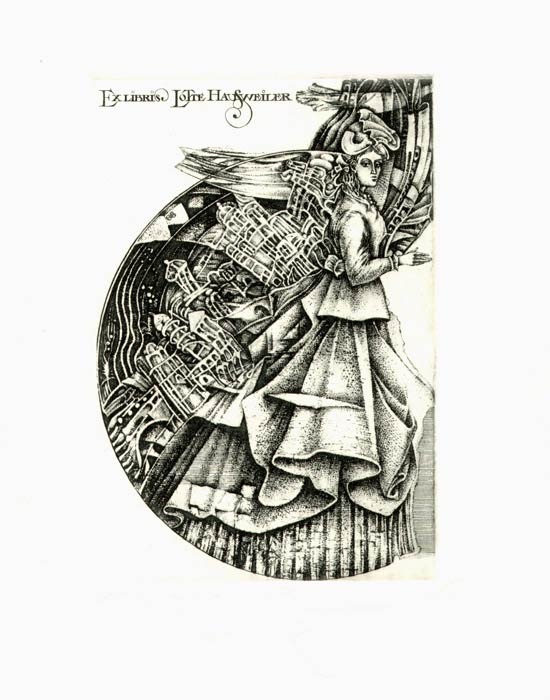
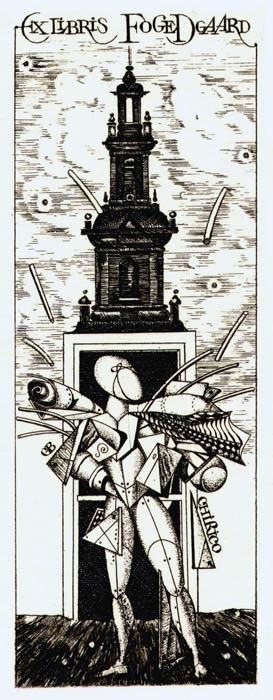
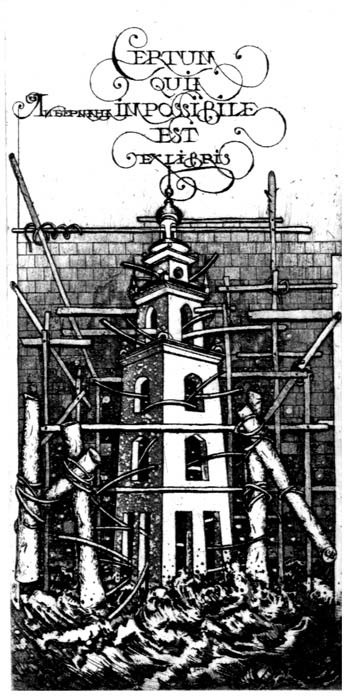
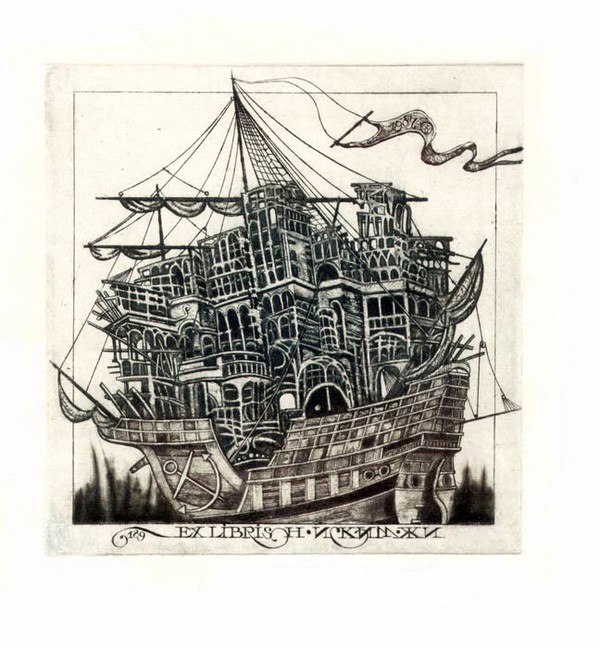
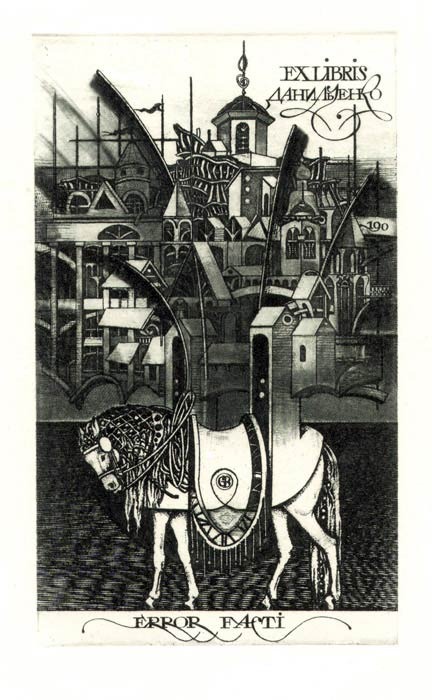
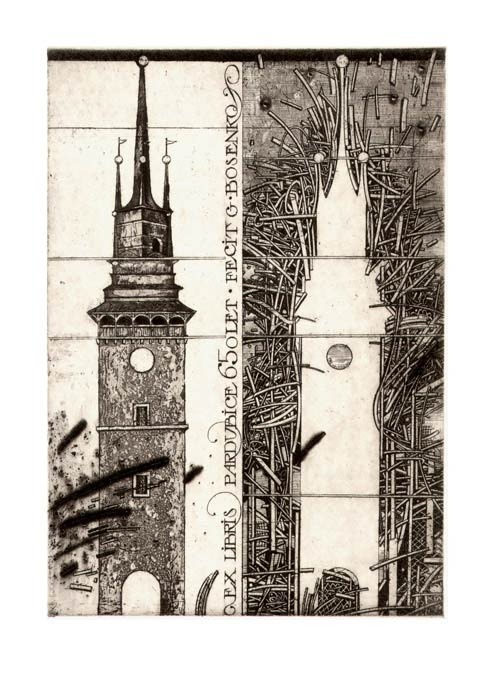
The architectural bookplates of G. Bosenko are distinguished above all by a certain degree of being thoroughly “worked out.” They are executed at a high technical and stylistic level. Chronologically, they reflect the evolution of his worldview and his approach to small-format graphic art.
The early architectural works in his bookplates have the narrative character of a formal planar construction. They are small easel engravings supplemented with text, in which the typeface is insufficiently individualised (for example, the bookplates of T. Alexandrova, 1971, and I. Golsha, 1972).
In recent years, significant progress has been made in the creation of bookplates. Tendencies towards the functional and constructive formation of the miniature through contrasts and multiple planes have emerged and continue to develop. The engravings become more dynamic in their composition, silhouettes and placement of type. They acquire their own specific tone and printing colour. This is their external aspect, but the principal element is their content, their semantic burden, without which a bookplate cannot exist. All the bookplates of recent years are filled with action; in all of them, one senses an attitude towards architecture founded upon the artist’s understanding. It is a world of different images: the world of children and adults, the world of theatre and the stage, the world of landscapes and ancient castles (for example, the bookplates of Nikolka, 1986, and Piilmann, 1986). From G. Bosenko’s art of small-format graphics, an integral and figurative structure of fantastic architecture rises before us, which he loves selflessly and attempts to convey to the viewer with the bookplate owner’s agreement. For him, there is no “minor” genre; he is always thoughtful in constructing graphic spaces and creating a mood. His creative aspirations are directed towards the search for diverse techniques: combining classical drawing with a fantastic environment, changing the tonality of the engraving, shifting relationships of scale, and adopting a serious attitude towards the owner of the bookplate and the “hero” of the image. It is also significant that, in his bookplates, the artist persistently leads the viewer towards the need for a philosophical interpretation of the action and deep immersion in the depicted world. Possession of a sufficiently developed concept and an understanding of compositional and plastic tasks, together with the use of formal and technical techniques and means, serves as an impetus driving the creator towards searches and the discovery of new horizons. Above all, this concerns the understanding of the classical, traditional and contemporary bookplate. The clarity of the artist’s position is largely explained by his consistent attitude towards the theme (the sequence of events), stylistic interpretation (the observance of certain rules and the relationship of the image to the plane, scale and texture), and the staged illustration (a performance synthesising different aspects of worldview). (For example, the bookplates of Zawistovscich, 1991, and A. van Waterhoot, 1992.)
The author’s position is the path of improvisation, revelation and artistry. This extensive and important stage has now reached its conclusion. The artist’s small-format graphic art has acquired recognisability.
It is difficult to say whether G. Bosenko will encounter a new form of representation or enter yet “another” creative world, but there appears to be no doubt that he has succeeded in entering contemporary graphic art.