2010
“New Year’s Greeting Engraving PF (pour féliciter)” /article/
“The Bibliophile’s Almanac,” Issue XXXIV, pp. 106-117
Moscow. Published by “MSOOK and MSK”
New Year’s Greeting Engraving - PF (pour féliciter)
For many years, such an intimate genre of small-format graphic art as the New Year’s greeting engraving, the so-called “PF” (pour féliciter), which translates from French as “for congratulating,” has existed (with a tendency to fade away). What makes this small miniature unique? The singularity of its original source? The primacy of the original? Its handmade nature, or the close connection between the gift of the artist’s imagination and the initiator of the greeting? A greeting engraving is produced on commission from a private individual or an organisation, as well as by an artist for personal greetings.
In essence, a “PF” is a postal card printed in a limited edition, and this graphic art may therefore be regarded as a postcard.
The first postal card was issued in Austria-Hungary in 1869. In the Russian Empire, “open letters” appeared in 1871. After Russia joined the Universal Postal Union, inscriptions in Russian and French appeared on them. In 1894, the Russian Minister of Internal Affairs authorised privately produced open-letter forms. From then on, the imagination of publishers knew no bounds. The postcard has always been an active participant in events. The postcard congratulates us on significant dates and family celebrations. The postcard preserves for us the appearance of architectural and artistic masterpieces. The postcard presents us with an entire world in all its diversity.
A postal card is a mass-produced typographic product, while a one-off postcard created by a graphic artist has a limited print run and bears the author’s signature.
What role can this small form be assigned in education, advocacy and the cultivation of artistic taste? Is it not part of the general artistic culture? Is it not an element of the material and historical culture of the lives of people from different countries?
Small forms of graphic art are a type of engraving that is highly specific in its principles. It includes four principal categories:
-small-format easel graphic art - a thematic engraving of small dimensions (up to 20 cm along its longer side); this category also includes aphoristic graphic art, that is, a concise and succinct graphic aphorism on a particular theme.
-occasional graphic art - an engraving created for a particular circumstance, celebration or event, indicating the dates on which it is held.
-ex libris - a bookplate with which a bibliophile marks a personal library (translated from Latin, ex libris means “from the books”). Its permissible dimensions are no more than 12 cm along the longer side.
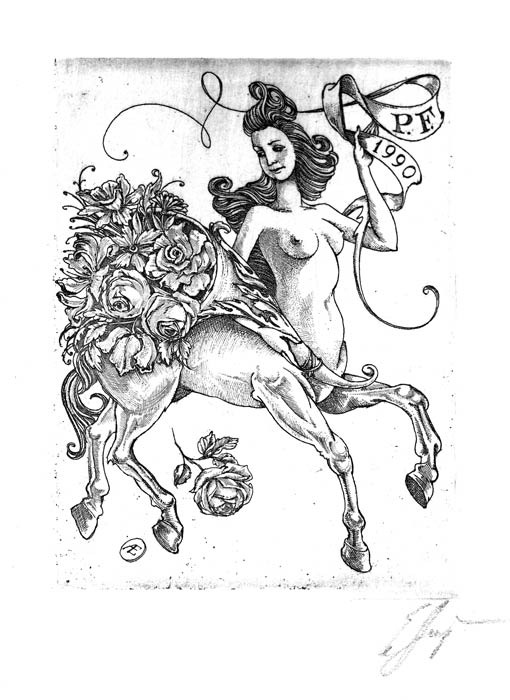
- New Year’s “PF” (pour féliciter) - a personal greeting engraving that may be created by an artist for personal use or, at a customer’s request, in a unique artistic form. It is engraved and printed according to the same principles as a bookplate. As a rule, it bears the year and the surname of the sender and, of course, “P.F.” in abbreviated or full form. Upon receiving such a greeting engraving, one can immediately see, without any additional text, who is sending the greeting and who created the small-format work, because the artist-engraver always places personal initials on the engraving.
Increasingly rarely does the New Year’s “PF” become a commissioned object and the face of its owner. It acquires a new social function as a metaphorical portrait of the artist. Graphic artists begin creating New Year’s greetings for themselves, signing them and exchanging them. This becomes a distinctive school of craftsmanship where they can demonstrate their taste and skill to colleagues and collectors. The theme is free and unrestricted. Almost all bookplate artists have passed through the “school of the greeting card.” The circle of the personal “PF” greeting engraving and its “souvenir” role gradually expands. The number of collectors grows, and this lively genre, responsive to the events of life, gains strength. Nevertheless, the “P.F.” favours the celebration of the Nativity of Christ or the New Year.
The creative biographies of masters of personal greeting engraving from different generations form a convincing sequence testifying to the rapid growth of this phenomenon and its international popularity.
Let us attempt to examine more closely some greeting engravings by masters of this genre.
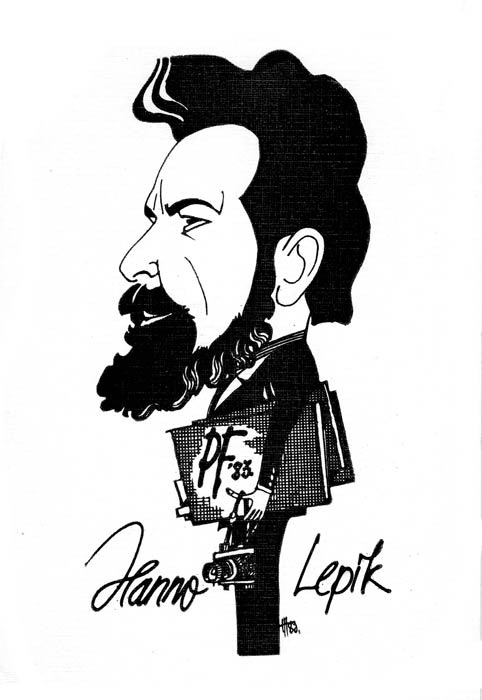
The caricature portrait of Hanno Lepik, created in ink for “PF-83” by the Estonian Hugo Hiibus, is characterised by its compositionally stylised manner. Swirling lines, intensive washes and hatching reveal the facial features collectively rather than separately: the lines of the brow ridges, nose and hair are all perceived immediately, without close examination of the details. A distinctive “billowing” lock of hair establishes the connection between the text and the figure. As a whole, the figure is rendered in a grotesque, static position extending from the slender legs to the disproportionately large head. The figure gives the impression of inner tension, yet at the same time of stability. The camera in his hand identifies his principal occupation, not to mention his collecting of bookplates.
There is an expression, “to draw at tempo”; that is, to convey the quintessence of a phenomenon. This refers not only to the physical speed with which a drawing is executed, but principally to the artistic tension conveyed through line and stroke. This may be applied to the “PF-1987” of Inge & Klaus Rödel, created by the Danish artist Erik Skjoldborg. The drawing of the urban landscape emerges from a capricious line: swift and nervous, now sparse, now condensed into a solid area. It falls in vertical and horizontal strokes, suggesting subjects of urban landscapes, architectural monuments or architectural fragments. And this represents a particular stratum of history, culture and architecture. Antiquity is combined in an astonishing way with sensuous immediacy and emotional state. Few can allow themselves to choose this theme for a greeting engraving.
The great master of German engraving, Professor Hermann Huffert, created the New Year’s “PF-1990” for the well-known Italian bookplate collector Mario de Filippis. The leitmotif of the New Year’s greeting he created was the biblical story in which we see the Magi travelling from the East to Bethlehem to worship. The star that they had seen in the East guided them and finally stopped over the place where the Child was born. The artist’s ability to convey the theme to the viewer depends on love for what is depicted, inner culture and craftsmanship. In this wood engraving, one perceives wise concision of form, classical clarity of line and an impression of illumination and flight.
Another “PF-1993” based on the biblical subject “The Holy Family” was created for himself by the renowned Lithuanian artist Antanas Kmieliauskas. The personal greeting engraving was printed as a coloured relief print from a cardboard matrix. The character of the line and stroke in this manner differs from that found in classical techniques.
An interesting work by the Estonian master Vello Vinn was commissioned by the Estonian Artists’ Union in 1977. It is a triptych consisting of a forest of burning candles, a New Year’s clock displaying “twelve degrees,” and text woven into a glowing light bulb. The semantic accents, seemingly radiating from the centre of the sheet towards its edges, resonate at full force (with an almost lubok-like simplicity of representation). The schematised composition is boldly conceived, with flattened space and a rhythmically organised drawing. The search for an expressive graphic style characteristic of the late 1970s is evident. This artist is characterised by the construction of an “estranging” everyday subject, irrational or fantastic, with the organic application of realistic elements. The engraving’s distinctive features are its compositional relationships, graphic plasticity and concise colouring (in this instance, the colour is umber). All this opposes the real event rather than conveying it, even conventionally. Through their very unexpectedness and freedom from objective meaning, the artist must apparently elevate the depicted subjects (some light bulbs with candles or bottles with wings) from the realm of simple observation into the sublime sphere of the “great” New Year’s night.
In the New Year’s “PF-89,” the Lithuanian artist Alfonsas Čepauskas depicted King David. He created a synthesising image of the epic, focusing attention above all on the king’s strength, power and courage. He found his own key to resolving the image and the atmosphere as a whole. The graphic artist deliberately saturates, condenses and masters the space of the engraved plate. The proportions and scale of the figures are exaggerated. Decorativeness, intensity of colour and strictness of line characterise the style of the miniature.
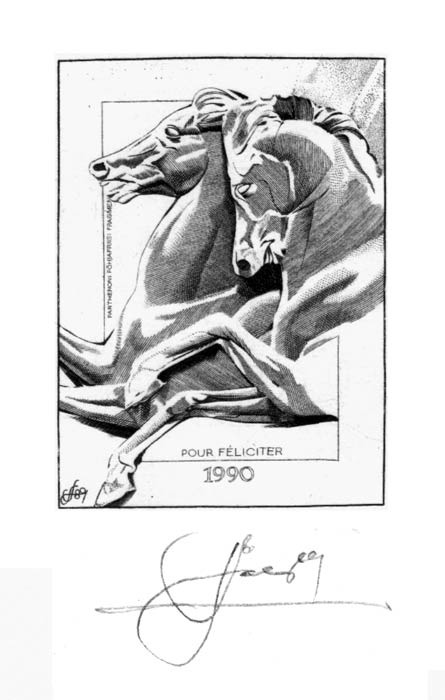
One of the early greeting engravings by the renowned Estonian artist Lembit Lõhmus contains a mischievous engraved subject: a winged Cupid tears the dates of the departing year from a wall, revealing “PF-1995” behind them. This simple subject on the theme of the changing year is skilfully engraved and evokes a very warm response. Pour féliciter-1990, executed by the same master with a burin on copper, is distinguished by its filigree craftsmanship. According to the Eastern calendar, 1990 was designated the Year of the “Horse,” and the artist based the work on images of horses from the Parthenon frieze. Much could be written about Lõhmus’s personal greeting engravings. The “PFs” he created are highly expressive and rich in content. Conception and execution are united in them, while the diversity of subjects and images is impressive. All this testifies to the creator’s high level of professional mastery.
Another greeting engraving on the theme of the Zodiac is “PF-84” - the Year of the Mouse - by the Israeli artist and bookplate creator Leonid Kuris. This engraving on plastic was executed with a sense of humour. The image of the model - the shoulders, chest and hands holding information - is executed as though the artist were seeking to reveal the whole and the particular, the volume and plasticity of the depicted object. It is interesting to note that the portrait, created through line and stroke, is in a state of astonishing calm; it conveys the profound concentration and confidence of the woman portrayed as the coming year approaches.
The Moscow artist Maria Churakova created “PF-66” for Semyon Georgievich Ivensky, the well-known promoter, collector and artist of bookplates. The frosty, fragile and untouched nature of a Christmas forest and a fox lying in wait; a character from many Russian fairy tales and bylinas. The classical modelling of the wood engraving in light and luminous strokes, behind which one year conceals itself and departs while another is outlined and already begins to emerge.
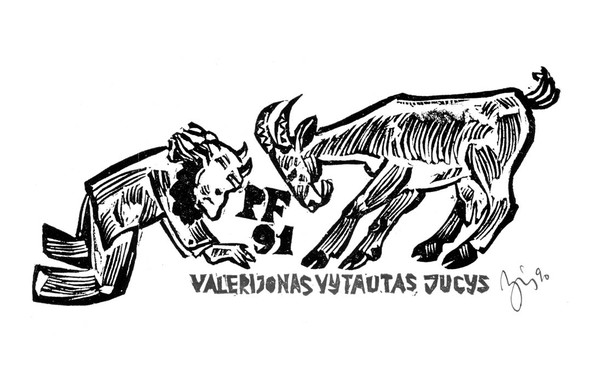
Valerijonas Jucys endows almost all his New Year’s greetings with humour and a self-portrait. Such is “PF-1991,” the Year of the “Goat.”
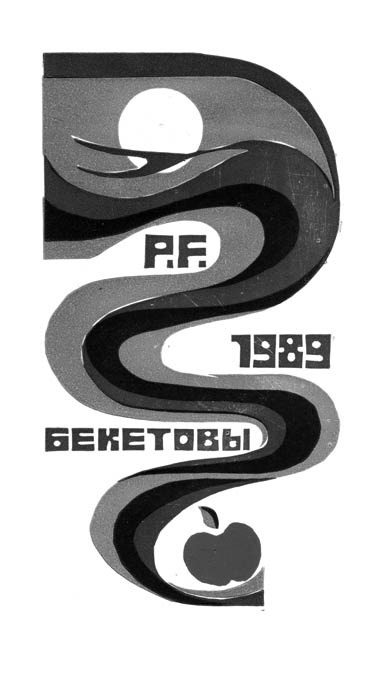
In creating the family “PF-1989,” Lev Grigoryevich Beketov, a Crimean artist, likewise did not miss the opportunity to commemorate the Year of the “Snake.”
The New Year’s “PF-1987” of Mikhail Minkevich was created by the Belarusian artist Gennady Grak. It is a two-colour linocut with the attributes of an edition: a city at night, a cat and a Christmas tree. The semantic and visual emphasis is a striped cat - a synonym for house slippers and tranquillity. This apparently refers to the desired character of the coming year.
Vladimir Sheiko, an artist from Moldova, based the greeting engraving “PF-91” on a festive folkloric element. Kolyada is a Slavic festival symbolising the perpetual succession of one year by another. From this day onward, “daylight” begins to increase and the night becomes shorter. The sun, the circle and fire are symbols of the festival. Girls and young men usually went carolling in the evening. The mummers wore animal skins, horns and beards. A disguised goat also appeared. Thus, through a colourful ethnographic detail, the artist emphasises the passage of time; from rituals to “PFs.”
Sometimes artists do not engrave the inscription “PF,” but simply inscribe the printed engraving for the occasion and sign it. Thus, the works presented here by the celebrated masters A. Brunovsky and A. Kalashnikov illustrate this form of greeting.
Over time, the greeting engraving has evolved to such an extent that it has become an independent field, while its finest examples demonstrate the virtuosity and filigree craftsmanship characteristic of a masterpiece. The multiplicity of forms in which the “PF” is executed makes it impossible to encompass fully every aspect of the development of the festive greeting or to predict the paths along which this genre will develop.
The classification of small forms is taken from S. G. Ivensky
/illustrations from the author’s personal collection/