2010
“On the 100th Anniversary of the Birth of Lazar Dubinovsky”
“Chișinău Observer,” No. 7 (716), 25 February 2010 /p. 15/ Chișinău
On the 100th Anniversary of the Birth of L. I. Dubinovsky
Through his achievements and explorations, L. I. Dubinovsky paved the way for monumental art in Moldova.
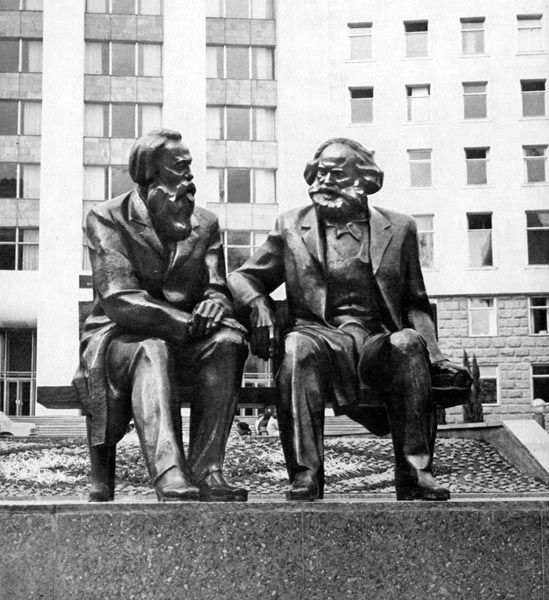
In my life, I had the opportunity not only to communicate with a great sculptor (which I can say without exaggeration), but also to collaborate with him. In 1976, I was working on project documentation for the landscaping of the grounds of the Administrative Building of the Central Committee of the Communist Party of Moldavia. The project also included the design of a granite pedestal for a two-figure composition dedicated to the founders of scientific communism, K. Marx and F. Engels. L. I. Dubinovsky worked on realizing the concept with his characteristic energy. The urban-planning situation was quite complicated, and the maestro developed more and more new versions, coordinating them with the “client” - the First Secretary of the Central Committee of the Communist Party of Moldavia. All the versions were interesting and could have been successfully implemented, but the sculptor was seeking a non-traditional solution. The task was further complicated by the fact that these two men (K. Marx and F. Engels) differed greatly in height and significance.
Numerous monuments had been made to K. Marx and F. Engels individually, but a joint monument to the two aforementioned classics is an exceptionally rare phenomenon.
In Dubinovsky’s final sculpture, the leaders are depicted sitting on a bench. With great tact and skill, the sculptor resolves the subordination and coordination of the figures of the short, broad-shouldered K. Marx and the tall F. Engels. The two temperaments reflected in the figures’ seated poses find further development in their portrait characteristics.
I had the opportunity to attend discussions and reviews at the Ministry of Culture and to observe the monument being executed in the workshops of the restoration combine itself. I recall my meetings with Lazar Isaakovich with immense pleasure, as well as my meetings with the creative collective of his assistants: the sculptors V. Rotar, Yu. Horovsky, S. Dubinovsky and S. Rabinkov.
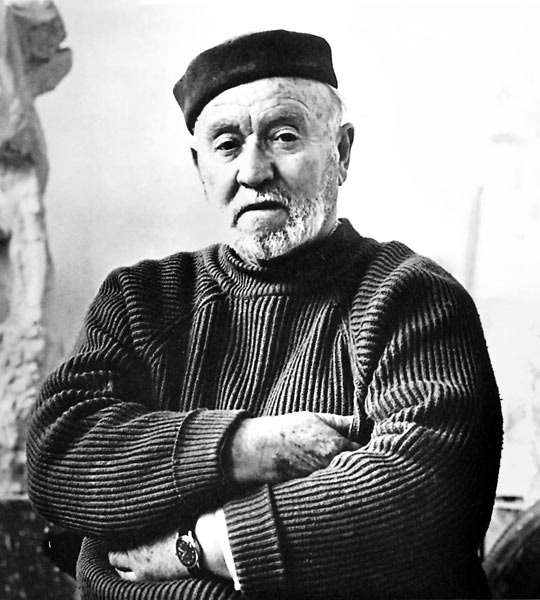
LAZAR ISAAKOVICH DUBINOVSKY
(1 May 1910, Fălești - 29 November 1982, Chișinău)
People’s Artist of Moldavia (1963).
Corresponding Member of the USSR Academy of Arts (1964).
Laureate of the State Prize of the Moldavian SSR (1970)
Honorary Member of the Romanian Union of Artists (1960)
Honorary Citizen of Fălești
Awarded the Order of the Red Banner of Labour (1948)
Awarded the Order of Lenin (1960)
He was born in 1910 in the village of Fălești, in Bălți County of Bessarabia Governorate, into a teacher’s family. In 1917, the Dubinovsky family moved to the city of Bălți, where young Lazar entered school. While studying at the gymnasium, he attended drawing-circle classes, where, under the guidance of I. V. Savin, the young man received his first schooling in drawing.
In 1925, wishing to continue his studies in the visual arts, Dubinovsky entered the Bucharest Academy of Fine Arts. For the first two years, he worked in the studio of the excellent portraitist and passionate admirer of Michelangelo, the sculptor D. Pachuri. The years of study under this versatile master laid the foundations for his understanding of classical sculpture. Dubinovsky spent his remaining years at the Academy under the guidance of the remarkable teacher Oscar Han.
At the end of the nineteenth and beginning of the twentieth centuries, the foundations of the progressive French school of realistic sculpture were laid in Paris. This attracted the young sculptor Dubinovsky, and in 1929 he arrived at the studio directed by A. Bourdelle. Although A. Bourdelle did not teach at the official Academy, he did much to develop the young talents who gathered in his studio. In his time, the sculptor Vera Mukhina, author of the famous composition “Worker and Collective Farm Woman,” also studied under Bourdelle. Dubinovsky became acquainted with Parisian exhibitions and the treasures of Parisian museums and visited artists’ studios. After Bourdelle’s death, continuing to remain in Paris seemed pointless to Dubinovsky, and in 1930 he returned to the Bucharest Academy, studied for another year and defended his diploma by completing the sculpture “Prometheus in Chains.”
After graduating from the Academy, Lazar Dubinovsky returned to Bessarabia, to his native city of Bălți. Dubinovsky taught drawing and calligraphy at the gymnasium while continuing to sculpt in his free time, working mainly in the portrait genre.
In May 1939, the first solo exhibition of L. I. Dubinovsky opened at the Trianon Theatre in Iași. The exhibition presented five sculptural portraits and five sculptural compositions.
In 1941-1942, Dubinovsky took part in battles on the fronts of the Great Patriotic War. He was wounded. While recovering in the Irkutsk military hospital, he created a series of compositions that were exhibited there in 1943.
After demobilization, from 1945 to 1951, L. Dubinovsky was head of the Department of Visual Arts in the Committee for Arts of the Moldavian SSR. During this period, he created his famous work “Strymbă Lemne” (in plaster; in 1959 the sculpture was transferred into tinted aluminum and is kept at the National Art Museum of Moldova).
Lazar Isaakovich Dubinovsky’s restless energy brought him to Moscow in 1951, to the monumental creative studio of E. V. Vuchetich, where he worked until 1953.
In the studio, the sculptor developed methods for selecting material, interpreting the model’s surface, and subordinating form and color. All of this would later occupy an important place in Dubinovsky’s plastic system.
Upon his return, the sculptor created his most significant monumental works.
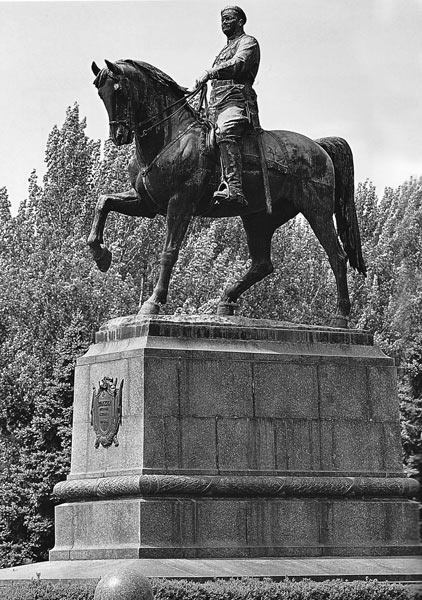
Thus, in 1953, a monument to the Civil War hero G. I. Kotovsky was erected in Chișinău. It was created by L. Dubinovsky together with the sculptors K. Kitaika, I. Pershudchev and A. Posyado and the architect F. Naumov. The five-meter bronze equestrian statue, mounted on a red-granite pedestal, recalls in its silhouette a solution rooted in the examples of the Italian Renaissance. The authors chose the classical path, creating not a symbol but an image. They found a convincing subordination of details without disturbing the integrity and sense of monumentality. It is the only equestrian sculpture in the city executed at a very high professional level. Undoubtedly, this was a great success for the creative collective.
The next work was the relief “The Art of Moldavia,” executed in 1953 on the pediment of the newly built Moldavian State Theatre of Opera and Ballet (architects V. Smirnov and V. Alexandrov).
In 1958, the creator Dubinovsky began implementing the “Alley of Classics” project in the city park named after A. S. Pushkin (today, Ștefan cel Mare Park). Together with the architect F. Naumov, he erected three bronze monuments in this alley: a portrait of the writer G. Asachi, a portrait of the poet M. Eminescu and a portrait of the writer V. Alecsandri.
Earlier, in 1957, the State Tretyakov Gallery had purchased for its collection a plaster portrait of the poet M. Eminescu. The Tretyakov Gallery’s acquisition signified great recognition for the master.
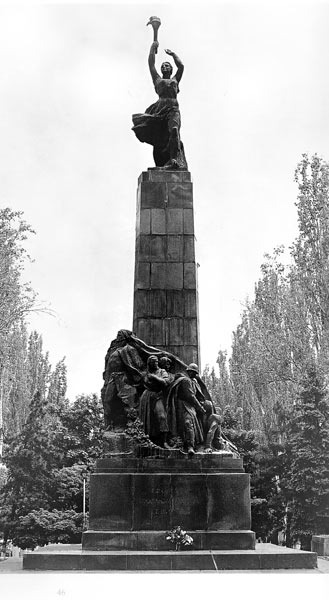
In the summer of 1959, the city of Chișinău received another masterpiece - the monument “To the Heroic Komsomol” (architect F. Naumov). The monument is dedicated to the struggle of Moldavian Komsomol members on the fronts of the Great Patriotic War and in the underground, and to the liberation of their native land from the “brown plague of the twentieth century.” Its creation took two years. The twelve-meter obelisk with a bronze high relief and a crowning figure of a girl with a torch became a vertical dominant organizing not only the square in front of the monument, but also the entire Youth Avenue (today, G. Vieru Boulevard; before the monument was unveiled, the street was called Central Ray).
The bronze high relief at the base of the obelisk is a narrative about the sons and daughters of Moldavia, whose courage and selfless devotion to their Motherland will remain forever in the people’s memory. The figures of the Komsomol members are imbued with enormous inner tension and the heroic pathos of struggle during years of harsh trials. The language of allegory is simple and clear. In this monumental work, the multifaceted nature of the sculptor Dubinovsky’s creative work revealed itself in a new capacity.
From 1964 to 1972, L. I. Dubinovsky held the responsible position of chief editor of the Visual Arts Department of the Ministry of Culture of the Moldavian SSR. He was the principal curator of the republic’s visual arts.
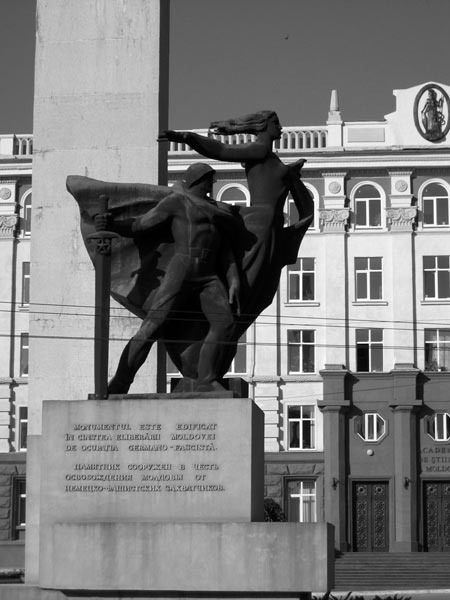
In the 1970s, the sculptor created his principal monumental works; by comparing them, one can trace the evolution of L. Dubinovsky’s creative work. The monument “To the Warrior-Liberators,” created in 1970 together with N. Epelbaum (architects A. Kolotovkin, F. Naumov, I. Gritsenko and A. Minaev), was also conceived in an allegorical key. The monument is a dedication to the Soviet soldier, symbolizing the army that defeated fascism, and to the Motherland, personified by a woman’s figure.
The composition is executed in a solemn register, while the majestic dynamism of the figures captivates through its harmony. The sense of movement is intensified by the powerful upward sweep of the memorial stele, embodying the eternal memory of the heroes.
The emotional impact of the figure of “Victory” and the liberating soldier expands the monument’s sphere of influence and includes the surrounding space within the artistic image. Despite the use of established methods in resolving the theme, this monument can be regarded as one of the finest monumental sculptural works in Moldavia.
The language of symbols and allegories, of artistic metaphor, which makes it possible to express the essence of a phenomenon or idea and reveal the image of a hero more broadly and richly, is often used by L. Dubinovsky in monumental sculpture.
From 1975, Dubinovsky worked on a project for a monument to the Civil War hero in his native city of Kotovsk. In the initial sketches, it was an equestrian statue - swift and unstoppable. In the course of the work, the sculptor abandoned the original concept and depicted Kotovsky as a commander and a fighter. Work on the monument was completed in 1976. It is an ensemble installed on a high hill above the city, resolved on two levels and at different visual scales. As one ascends the flights of stairs leading to the monument, one particularly senses the tense stillness of the entire group of figures. Enormous inner tension and the distinctiveness of a strong character are reflected in each image.
That same year, 1976, the sculptor was assigned an interesting and at the same time extraordinarily complex task: creating a monument to K. Marx and F. Engels. The difficulty lay in the fact that the monument was to be installed in a square in front of a modern multi-story building, in the immediate vicinity of the roadway of the city’s central avenue. The sculptor proceeded from the “architectural situation.” He based the composition on a contrast between the plastic forms of the monument and the volume of the building. As a result, against the background of the strict geometric divisions of the modern building, a sculptural group emerged - a monument not in the traditional understanding of the term. It fused the features of two genres into one: easel and monumental.
Installed on a low granite slab, the two-figure composition acquired a “human” scale and became an object bringing monumental sculpture as close as possible to the viewer. The leaders are depicted sitting on a bench in a state of continuing dialogue. The composition reads well when viewed from all sides.
The monument’s conception, its installation and the choice of material embody the artist’s extensive innovative search. The monument is made of wrought copper (“repoussé”) combined with the red polished granite of the pedestal. At that time, the technique of hollow sculpture was highly progressive and difficult to execute.
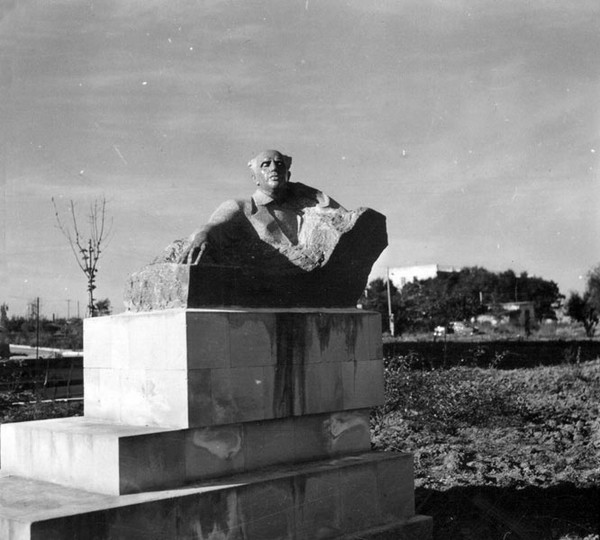
Special consideration should be given to the portrait gallery created by L. Dubinovsky. It is broad and diverse and embodies the psychological and individual characteristics of every person depicted.
The sculptor is captivated not so much by the external beauty of the person portrayed as by the complex, each time new and unique world of the character’s feelings and experiences. This explains the sculptor’s heightened interest in creative personalities and his great success in portraying his contemporaries.
L. Dubinovsky’s achievement in portraiture at the end of the 1940s was the portrait of the outstanding Soviet architect and academician A. V. Shchusev, an image marked by profound psychological insight and complexity. The postwar portraits of the violinist O. Dain and the poet E. Bukov can also be assigned to this period; in them, the artist succeeded in recreating sharply characterized and truthful images of people of great creative giftedness. The portrait of Arkady Raikin is warmed by great inner warmth and marked by deep intelligence. The architect R. Kurtz is presented to us immersed in memories.
No less psychologically profound in its treatment of the image is the portrait of the Moldavian writer and academician A. Lupan.
In 1960, the sculptor created a memorial bust of Ștefan Neaga - composer, pianist and teacher, whose creative work in many ways determined the development of musical art in Moldavia.
The monumental half-figure of the composer Eugen Coca is resolved differently. He is presented as though standing at a conductor’s lectern before an orchestra. The gesture of his hands seems to encompass the space before him. All the plastic devices are subordinated to revealing the inner expressiveness of the image.
The expressive portrait of the architect G. Solominov is presented in a new way. The concise volume of the head is contrasted with the pedestal - an inverted capital. This device reveals the complex and contradictory character of the audacious “overthrower” of classical forms.
The portrait of the woman artist M. Tsoncheva is psychologically rich and lyrical. There is the romantic exaltation of the plasticity of the portrait of M. Eminescu and the “severe” constructive treatment of the volumes in the portrait of Academician Scriabin. The portrait of the cinematographer E. Tissé has concise and concrete forms; the portrait of D. Oistrakh has monumental volumes; the Moldavian men of letters D. Cantemir and M. Costin are rendered with refined sharpness of form; and there is the entirely contemporary portrait of the young A. Zevina.
A sense of mighty strength, energy and will emanates from the memorial bust of the writer A. M. Gorky, executed by the sculptor in 1975-1976. Dubinovsky modeled the writer’s head with generalized forms. The face is powerfully and energetically modeled, conveying the inner dynamics and tension of the great writer’s image.
One could continue for a long time listing the works created by our fellow countryman - a talented sculptor and creative person. But in the art of L. Dubinovsky, the source of inspiration and the principal hero of his works remain unchanged - the Human Being.
Turning to the experience of the world’s sculpture of the past, the sculptor succeeded in creating memorable works filled with harmony. At the same time, in every work by L. I. Dubinovsky one senses a search for new solutions and means, and the constant enrichment and development of forms.
“Requiem: Dedication to the Victims of the Nazi Death Camps” (1982)