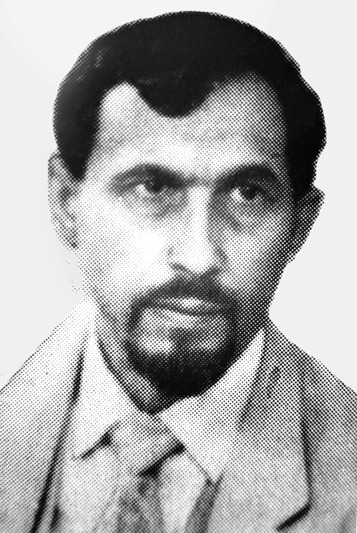
Yuri Tumanean
- the person who helped me understand and formulate my approach to creativity. My first serious meeting with Y. B. Tumanean took place in the autumn of 1978 in the old building of the Union of Architects (now the administration of the Republican National Museum of Fine Arts). Yuri Bogdanovich was sharing his impressions of a trip to America. In terms of the speaker’s preparation and the systematic and carefully verified presentation of the material, it resembled a lecture more than anything else. I later learned that, after returning from the United States, Tumanean did not communicate with anyone for three months: he was digesting his impressions and gathering his thoughts. During the aforementioned meeting, he presented an analysis of the urban planning and contemporary architecture of a number of American cities. When the restrained expressions of admiration at what we had heard about the United States had subsided, I seized the moment, approached him, and expressed my gratitude and satisfaction with what I had heard. After asking my surname, the lecturer said that he had long known it from fellow architects and from observing the artistic life of the republic. Naturally, I was flattered.
Together we went for a walk around the city of Chișinău, asking each other various questions and listening closely to the answers. The final phase of our excursion was an invitation to collaborate at the Chișinăugorproekt Design Institute, headed by Y. Tumanean. At that time, a cohort of interesting, talented architects worked there, and a new creative studio, “KM 7,” was due to open. Some time later, I joined it as its third Chief Project Architect. The two teams already in place were headed by the architects V. Klevensky and V. Bessonov.
My work at the institute began with Yuri Bogdanovich closely observing my work, or rather my creative activity; apparently, he felt responsible for having invited me. I was given the opportunity to form a team of designers at my own discretion. It was an ideal opportunity to begin, as they say, with a “blank slate.” Tumanean often visited our studio and observed the new team’s creative explorations.
I liked the fact that Yuri Bogdanovich took part in all the institute’s projects: sometimes with advice, sometimes with assistance, and sometimes with his own hand. I remember as if it were today the projects that the chief architect “brought up to standard” and that now adorn the city. He never inserted his name into anyone else’s work-I mean false authorship-and never “applied pressure” in that regard. He could offer advice, provide direction, and sometimes, when necessary, refine any of the institute’s projects if the need arose. The design organization he headed had its own identity, style, and hallmark. He devoted tremendous effort and the talent of a creative leader to achieving this. He valued it greatly, as is still evidenced today by the buildings and structures whose construction he supervised so carefully.
We met with the chief architect at the institute more and more often. He began visiting me in the studio and inviting me to his office.
My most unforgettable impression was from my first visit to the home gallery of Tumanean the artist. Many works hung on the walls. They alternated-paintings with graphic works and vice versa-in accordance with the requirements of the interior. Some works stood in a separate room set aside as a studio. These were mainly works executed in oil on hardboard. Tumanean began mastering these artistic media in Chișinău. Watercolor and pencil belong primarily to the Alma-Ata period. In all his manners, the creator adhered solely to Filonovian analysis, in a balanced palette and “point.” The technique of applying the paint layer had likewise been studied and borrowed by him from P. Filonov. The apotheosis of this school was Tumanean’s replica depicting twenty-four human heads taken from various paintings by P. Filonov. After writing two treatises, “The Analytical Art of P. Filonov” and “Post-Analytical Art,” Y. Tumanean somewhat changed his manner and technique of painting. He also founded and headed a school of analytical art.
The master was highly demanding and selective with regard to his own work. After he acquired a studio of his own, we began meeting even more often, talking and discussing artistic issues. Whenever possible, the host tried to invite an architect or artist he knew in order to hear their opinion of his work as a painter. I will note at once, without naming names, that he received no satisfaction from revealing his innermost creations or from the answers to his questions. Yuri Bogdanovich often wondered and asked me: “How can one engage in our profession and fail to understand, fail to feel, or, moreover, not be ready to perceive what is depicted in these paintings?” That was exactly how many of those to whom he showed his work reacted: “I am not ready for this.” In the end, the maestro concluded that there was no point in “undressing” before everyone, and he discontinued his experiments in displaying his artistic work.
At a certain stage, Tumanean began reviewing, culling, and destroying his works. I cannot say what prompted him to take such a step. He retained what he considered the finest and most important works, framed them, and catalogued them. This inventory was subsequently supplemented with new works and exists to this day.
Interestingly, the creator’s library met the same fate... He cut up all the books, systematized and grouped their contents by subject, and arranged them in folders. All the works of that period were the same size-80 × 80 cm. He designed the frames and cases for his works himself. It seemed as though he were preparing to move, which indeed occurred in 1991.
Y. B. Tumanean spent fifteen of his best years in the capital of Moldavia and was forced to leave Chișinău for well-known reasons: “In my way of life, in my creative work, in architecture, I am international, and I cannot abide such manifestations,” he said. At the age of thirty-four, it seemed to me that I had broken forever with my chosen profession of architecture (to which, by then, I had devoted eighteen years) and was ready to switch to an adjacent field. Tumanean uttered the momentous phrase: “If you want to achieve anything in the visual arts, eliminate the deficit of visual information and the deficit of knowledge of the history of the visual arts; fill the existing gaps; and, most importantly, acquaint yourself with the masterpieces of world art in the originals, which means visiting the Louvre, the Prado, the Hermitage, and other national galleries of the world. Only after mastering this can you find something of your own-personal and subconscious.” This was Yuri Bogdanovich’s succinct parting advice. Tumanean delivered many lectures in various fields: contemporary architecture, music, psychology, abstract and analytical painting. But most importantly, he succeeded in organizing the “School of Analytical Art” and formulating the concept of its development. As a fanatical adherent of this Filonovian movement, he considered it his duty to popularize, perfect, and transform this style. He needed to do so because he had set himself the goal of writing a treatise on analytical painting-or, rather, on post-analytical painting. To accomplish this, it was necessary to study P. Filonov’s legacy, describe its principles and techniques, and then move further in the theory and practice of painting. Many years were spent on this titanic work.
Yuri Bogdanovich did not regard me as his pupil, although I consider him my indirect teacher. One day in 1982, he came to my studio in high spirits, loosened his tie, and said: “I have been allocated premises in the House of Youth, and I will open a school of analytical art there. Will you come with me to work with young people? I know that you do not command this color system and painting technique, but you do command thought, transformations, and etching. Many of your works indicate that you are following this path. And I need to incorporate and test an approach in black-and-white and tonal compositions. The new treatise must depart from the existing canon and lead us further.” The proposal was enticing, especially since several years earlier I had arrived at analysis without knowing anything either about it or about the apologist of this movement, P. Filonov. I had developed for myself an approach that I defined as “Drawing by the Method of Design.” In essence, this was an unconscious incursion into analytical art, and Tumanean understood it. I agreed, not yet realizing that I was becoming a hostage to this style for decades.
Fortunately, in the autumn of 1986, the first retrospective exhibition of Pavel Filonov opened in Moscow at the new Tretyakov Gallery. I went there to become visually acquainted with “analysis,” so that I could communicate with Tumanean as an equal, both in knowledge and in emotional engagement. Yuri Bogdanovich had been fortunate enough to encounter the work of this brilliant master in his youth. He was introduced to it by Pavel Yakovlevich Zaltsman, one of the pupils of Filonov’s school, who had been exiled to Kazakhstan. On one occasion, with a letter of recommendation, he sent the young Tumanean to Leningrad, to the storerooms of the Russian Museum, where all the genius’s canvases were kept on “drums.” In accordance with his will, his sister, Evdokia Nikolayevna Glebova (née Filonova), donated the artist’s entire creative legacy to that museum. There was only one night available. That was how Yuri Bogdanovich became acquainted with Filonov’s painting, after which Tumanean the architect linked his life forever with this style of visual art. May 1990 left me with many pleasant moments of communication with the maestro, when the “Design USA” exhibition was held in Chișinău. My studio was included in the orbit of the cultural programs. It was visited by Mrs. Rebecca Matlock, wife of the United States ambassador to the USSR; Eugene Kohn, a leading architect at Kohn Pedersen Fox; and many others. At that time, Tumanean and I presented our works together: I showed originals, while Yuri Bogdanovich showed slides. He wanted to test the response to his post-analytical works, since the American viewer was entirely unfamiliar with Filonov and unprepared to perceive him. After such events, we would remain alone, relax, and immerse ourselves in discussing the encounters. For him, this was a ritual: to prepare and deliver a presentation, and then to sum up the results. In the autumn of that same year, Tumanean formed a plan to move away from Chișinău. Through his own channels, he began exploring possible options and proposing cities to which we could move together. These proposals were made not only to me. He suggested organizing a kind of “oasis,” a habitat where everyone would be occupied with their own work. Together, we would design, teach, and relax. The proposed cities were not large, so he envisaged becoming a certain “cultural” stratum there.
Of several options, for particular reasons, the architect chose Stary Oskol in Belgorod Region. It was there that I visited him for the first time in July 1993. He was still the institute’s chief architect, and many projects and sketches likewise hung on the walls of his office. But these were projects of a different quality. They were not as powerful, grandiose, or expressive as those from Chișinău or Alma-Ata, and they bore the imprint of a provincial town and the post-perestroika economy. Among all the projects, a small chapel intended for the new cemetery in Stary Oskol stood out. It was beautifully proportioned and featured an abundance of finely developed details.
New works and new themes appeared in his painting. This creative stage unfolded against the background of works by Filonov’s pupil P. Ya. Zaltsman, who, in turn, had been Tumanean’s teacher. These were primarily collages based on works by the artist-teacher, incorporated and further developed into new compositions. They all hung in the large hall of the master’s apartment, which had interiors that seemed innovative to me at the time. Once again, as at our first meeting in Chișinău, we went walking, but now through Stary Oskol. Yuri Bogdanovich commented on the city’s architecture, spoke about the particular features and prospects of its development, showed me the best completed projects, and took pleasure in his recollections.
We spoke on the telephone quite often. I shared new impressions from my travels. I “tried them on” and tested their validity against Tumanean’s reaction. He compared my impressions with his own view of his time in foreign countries and cities. At that time, the curtain had only just begun to rise. We spoke about the growing role of design in architecture and about their mutual interpenetration. I threatened to gather my new works, bring them to him, and show them to him, and, most importantly, to hear everything he had to say about them, because Yuri Bogdanovich remains, to this day, my greatest authority in the evaluation of creative work.
Yuri Tumanean was an architect in everything. Why do I emphasize his profession? Because his entire foundation came from architectural education, architectural thinking, and the history of architecture. Everything was pedantically verified, logically constructed, and judiciously disrupted. This could be observed in his designs, his buildings, and his paintings. Every composition was refined to the utmost. His favorite phrase was heard constantly: “A work must be brought to the highest degree of mastery, to the maximum degree of finish, so that no place remains where one could point a finger.”
A profound passion for musical culture (a thorough knowledge of the works of W. Mozart), psychology (a substantial command of Sigmund Freud’s studies), and a more than serious fascination with the history of the visual arts were superimposed, like a palette, on the structure of his diverse interests, character, and personality. Tumanean was the embodiment of high creative standards in architecture and art. My last meeting with Yuri Bogdanovich took place in January 2006. I telephoned Yulia Borisovna Skvortsova, by then already the master’s widow, and asked permission to visit. We met, spoke on various subjects spanning an interval of fifteen years, and went to Tumanean’s grave. From far away, at the entrance to the cemetery, the large obelisk to Yuri Bogdanovich, made of black gabbro, was visible. And how symbolic it is that it stands some twenty-five meters from the church that was his final work of authorship. I peer at it and do not see many of the details and elements that he once proudly showed me in the design. But that is no longer important; what matters is that two great monuments to a great man stand in one place.
All thirty years passed before my eyes, from the time I first heard the surname Tumanean, which became an integral part of my life. Yuri Bogdanovich Tumanean was born on February 7, 1938, in Tashkent (he died on August 26, 1997).
He graduated from the Department of Architecture of the Tashkent Polytechnic Institute in 1961.
From 1961 to 1975, he worked in Alma-Ata at the Kazgorstroyproekt and AlmaAtagiprogor design institutes and taught a course in the history and theory of architecture at the Kazakh Polytechnic Institute.
The most significant creative work of this period was the complex of the central square of Alma-Ata, developed by a large group of authors under Tumanean’s direction and implemented in 1971-1978.
For the architecture of the buildings on the central square of Alma-Ata, Y. Tumanean was awarded the 1982 USSR State Prize.
In 1975, Y. Tumanean was invited to Chișinău, where he headed the creative team of the Chișinăugorproekt Design Institute. He supervised the development of a large number of projects for construction in Chișinău.
He was the author of many urban-planning projects:
- the detailed planning project for central Chișinău, and the development of Ilyashenko Street (now Albișoara Street) and Frunze Avenue (now Columna Street).
He was the author of major public buildings in Chișinău:
- the Supreme Soviet building (now the Presidential Palace); the House of Friendship with Foreign Countries on Sadovaya Street (now the Palace of Nationalities, A. Mateevici Street); the APO “Victoria” complex on Kievskaya Street (now 31 August Street); the Chișinău City Executive Committee building; and the Concordia Hotel on Rîșcani Hill.