My Encounters with KOLOTOVKIN
I do not know who else, after A. Kolotovkin, will be able to make the rulers come to consider a project either at the design institute or at the Union of Architects. Yet he succeeded in doing so.
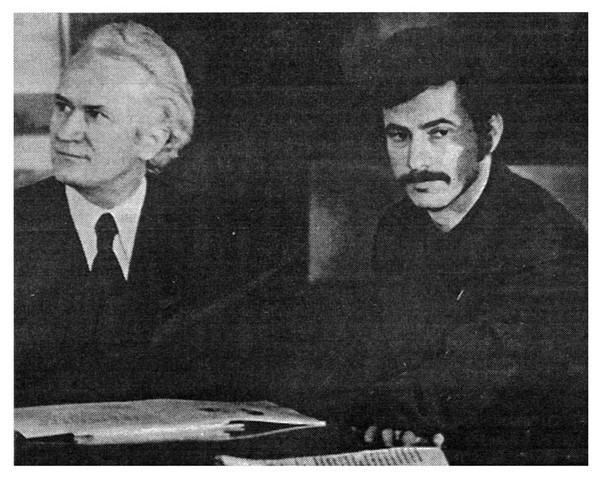
On 22 September 2003, Anatoly Vasilyevich Kolotovkin, Honored Architect of the Moldavian SSR, passed away. /Born 3 August 1928 in Konotop, Sumy Region./ After graduating from the Department of Architecture of the Lviv Polytechnic Institute, he was assigned to Chișinău. From 1953, he worked in Chișinău and designed a number of projects. From 1958, he was deputy chief architect of Chișinău. From 1964 to 1970, he was chief architect of Chișinău. From 1974 to 1992, he was director of the Molgiprostroy State Design Institute.
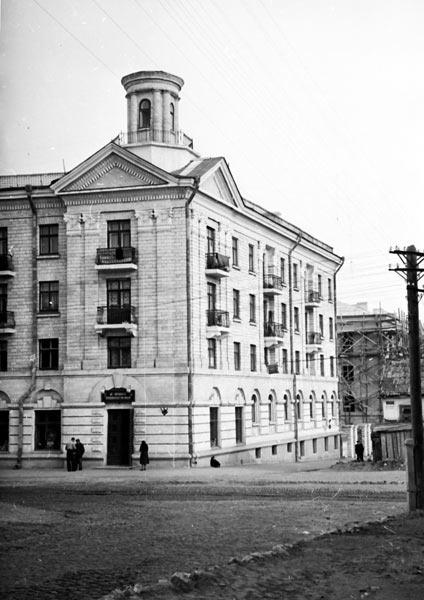
In my memory, the first mentions associated with the name Kolotovkin date back to the architect’s first completed projects, in particular the Ministry of Finance of the Moldavian SSR /1957/, in which my father, a professional builder, took part. The name was heard a second time in July 1970, when I participated in a competition project under the direction of architect S. Lebedev. Once, while examining details of the competition project, he said that he would apparently have to replace A. Kolotovkin as chief architect of the city. This replacement was predetermined by I. Bodiul, First Secretary of the Communist Party of Moldova, because of a number of violations in the field of the city’s architecture. In September of that same year, Kolotovkin, then chief architect of the Moldgiproselstroy design institute, came to the Polytechnic Institute, to the Department of Architectural Design, and began teaching practice with my group. I will say frankly that the ideological differences between his views and those of the students were great. He was an architect who had graduated before Khrushchev’s architectural reform, an official, a party bureaucrat; and we were young, soaring from Corbusier to Soleri, and did not want to think about the problems of economics and the “trends” of Soviet architecture. He did not even enter into discussion. At that time he was an authority: chairman of the Union of Architects of Moldova /1963-1990/, secretary of the board of the Union of Architects of the USSR, a deputy, with awards. Behind him were completed projects: residential buildings on Orhei-Columna /Frunze/ Street, 1955; the building of the Ministry of Finance of the Moldavian SSR /1957/; the Detsky Mir shop /now irretrievably “beautified”/; and Renașterii Boulevard /Molodezhi Avenue/, 1963. In 1977, in connection with errors made in the design of the administrative building of the Central Committee of Moldova, T. Ya. Tankikh was removed from the post of director of the Moldgiprostroy institute, and A. V. Kolotovkin was appointed. Thus, another encounter with Anatoly Vasilyevich took place, but now with him as director of the institute where I worked, taking part in the design of the Central Committee building. And again, progressively minded architects did not particularly applaud the appearance of the new administrator. The director-architect gradually began to become involved in the design process. Under his leadership, the following projects were developed: the building of the Ministry of Construction Materials Industry /1975/; the Alonka settlement project on the Baikal-Amur Mainline /1980-1982/; the building of the Molgiprovodkhoz institute /1980/; and the landmark work-the technical and economic justification for the complex of the Academy of Sciences of the Moldavian SSR /1978-1983/. It was with this project that the countdown to my departure from the institute began. Once, toward the end of the working day, a call came from the director’s reception office asking me to come in. I immediately went down from the third floor and entered the office. There, around the perimeter of the office, sat all our management elite: the chief engineer, chief architect, party organizer, trade-union organizer… Kolotovkin offered me a seat at the table and began to speak to me about my “talents,” which I was to apply in designing the grandiose Academy of Sciences complex project, unparalleled in Moldova. Naturally, a promotion was offered. After the panegyrics, I was shown a sheet with the typed names of the participants in the project, the so-called authors’ collective. There were only thirteen names, and I was the last. /The number thirteen was the maximum permitted for nomination for the prize./ Because of my youth, or other circumstances, I stood up and said: “I want to create projects, perhaps smaller, perhaps worse, but on my own.” The next day, I learned of the management’s bewilderment at my refusal. Despite disagreements with the institute director, we treated one another with respect, but kept our distance. We were two antipodes: one believed in the bright future of communism (?), the other did not trust developed socialism. Kolotovkin was always honest with himself, and his actions were dictated by the times and the regime of the former era. In 1980, A. Kolotovkin was awarded the title of laureate of the State Prize of the Moldavian SSR for large-panel residential buildings of Series 143, while I continued designing the Fruit-Growing Research and Production Association /in the Coșnița-Pîrîta area/. Once again a call came from the reception office: the materials for the Research and Production Association were urgently required by the director. I was to appear wearing a tie /I remember that there was terrible summer heat/ to report to the First Secretary of the Central Committee on the state of this facility. I brought the presentation boards into the office and saw an Anatoly Vasilyevich entirely unfamiliar to me. Holding a clothes hanger stand in his hands, he was in complete confusion, rushing from the office to the reception area and not knowing where it would be best to place it /what if Ivan Ivanovich came in outerwear/. The discussion went well. Bodiul liked the project and decided to take this facility under his own control. Two days later, Kolotovkin proposed expanding the authors’ collective, and I began to think about resigning. It was difficult to leave, with various tricks-the director would not let me go. But credit must be given to Anatoly Vasilyevich: he generously gave his authority, titles, and opportunities to the Union of Architects, which he headed for many years. Above all, this meant the Union’s building, its authority, and its events. Having left all his positions and living through perestroika, he continued to work and think very actively. At every meeting with me, he said that he had seen me somewhere on television or had read something, praised me, and took an interest in my affairs. These were brief encounters, now not with a party bureaucrat but with a curious, undaunted man, and this was very pleasant for me. On the occasion of his seventieth birthday, the government recognized the achievements of Anatoly Vasilyevich Kolotovkin with the Order of Gloria Muncii. Thus, without noticing it myself, I have run through a period of more than thirty years, very briefly and episodically. Undoubtedly, A. Kolotovkin will enter the history of the culture and architecture of the Republic of Moldova. Many, like me, will remember him in different ways. And the main thing is that he should be remembered and appreciated.