The typographic, handwritten ex libris-the prototype of narrative-compositional bookplates-has a centuries-old history. Books in those times were of exceptional value. The owners of libraries-monasteries, clergy, and feudal lords-marked their collections with a sign, thereby protecting them from thieves. Scribes made a written mark at the beginning of a book indicating that it belonged to a particular library or person. Later, books began to be adorned with a drawn vignette intertwined with initials. The oldest Russian handwritten mark is considered to be the ex libris of Hegumen Dosifey, the founder of the library of the Solovetsky Monastery (c. 1490). Drawn ex librises were not widespread and existed in the era of small libraries. With the development of printing, the drawn ex libris was replaced by an engraved label, separate from the book. These were pasted onto the inside of the binding or the endpaper in the form of an impression of a coat of arms, monogram, cipher, or text. A superexlibris-a sign or coat of arms impressed onto the outer binding-was also used. In the nineteenth century, a purely businesslike way of marking a book became widespread. A typographic bookplate appeared, containing information about the library, the book, and the owner. Its decorative-ornamental element predominated. As a rule, such marks were typeset display-type labels or stamps. The revival of the typographic ex libris as a distinct direction in the art of the bookplate dates to the second half of the twentieth century. During this period, the role of type design and artistic calligraphy increased. Type took a special place in narrative-thematic ex librises. As a rule, the typographic ex libris is reproduced by engraving a block or lithographic stone, by screen printing, or by typographic means. Today, computer assistance is increasingly used. The modern typographic ex libris vividly expresses the imagination, individuality, and temperament of both the owner of the miniature and the artist. The compositional perfection of the typographic bookplate is achieved through the correct selection of associative means of construction, interaction with content, constructive composition and the formal rendering of letters, and laconic expression of the form and grapheme of writing. The typographic bookplate is an object of contemplation and study. It awakens the imagination, evokes emotions, and introduces one to the world of subconscious perception. This miniature is an independent work of art with its own code, in which text is something more than a mass of letters standing one after another. Whatever it may be executed in-whether with a fine or broad-nibbed pen, a round or flat brush, engraved or drawn, made in a computer program or assembled by collage-the ex libris always remains an impulsive bearer of information and an active vehicle of contemporary culture.
15 June 2013
Type as a Sign. Bosenko 2006
Illustrations
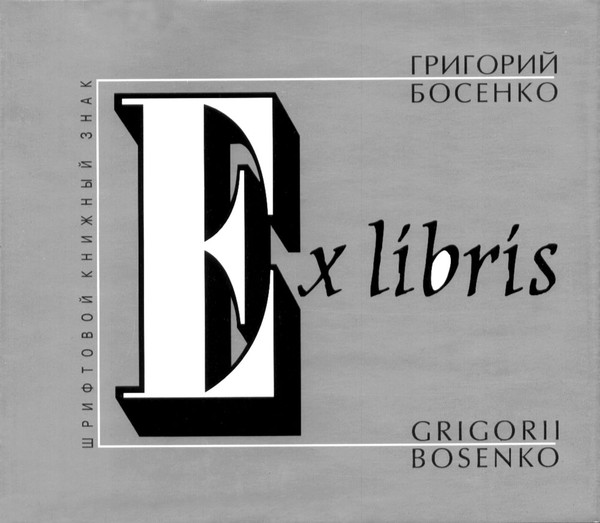
Author: Grigory Bosenko
Copyright protected