2009
“Russian Bookplate Journal,” Issue 10, pp. 47-50
Moscow. Published by “RAE and MSK”
“Vladimir Sheiko’s Typographic Symphony”
Vladimir Sergeyevich Sheiko was born in 1949 in Chișinău. He has worked continuously as an artist for Moldovan State Television. He has been engaged in bookplate art since 1975. He has created approximately 100 bookplates. He has participated in many republican and international bookplate exhibitions.
Today, Vladimir Sheiko’s art may be judged primarily by his bookplates and small-format presentation graphics. In this field, he revealed and fulfilled himself completely. Sheiko is steadfast in his pursuits and serves only three muses: television, where he has worked for approximately forty years; the bookplate; and the collecting of bookplates and stamps.
Not everyone succeeds in attracting immediate attention through their works as Sheiko did; his works became objects of collection for many collectors of bookplates. This is not only because the principal part of his work consists of small-format engravings, but also because the graphic artist approaches the expression of a theme in different ways and because every work is founded upon a sense of kindness, spiritual warmth and lyrical feeling.
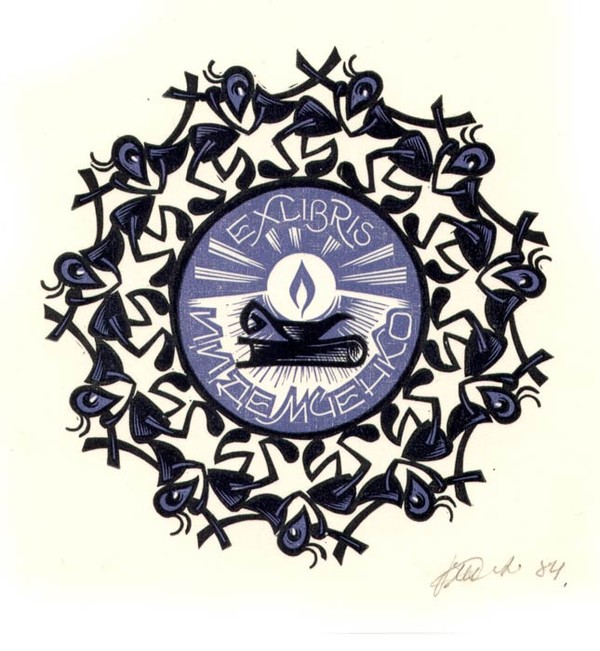
The circle of owners of the bookplates created by the artist is broad and diverse: singers and musicians, colleagues in work and art, researchers and young book lovers. These bookplates determine the diversity of narrative solutions, the choice of material and the character of execution: “ex libris,” “ex libris,” “From the Books,” “From the Books of A. and O. Belousov.”
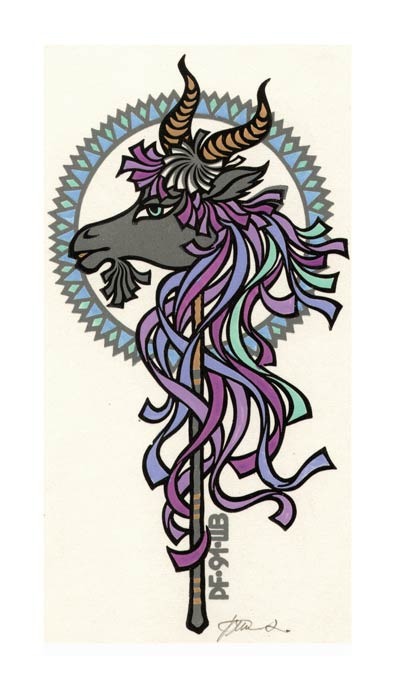
Each new work by Vladimir Sheiko in the field of the bookplate is a step towards perfection, a step in mastering engraving techniques and a step towards understanding relationships. It seems that, for the artist, there are no limits to expanding the possibilities of using various techniques in linocut or engraving on plastic. In his works, we see impressions of small-format graphic art brought to perfection, whether a black-and-white bookplate or a multicoloured “PF” greeting engraving. The graphic artist boldly varies the possibilities of printing technique, making the impression now exquisitely soft, now sharply contrasting, while at another moment his line suddenly becomes light against a dark background, or vice versa.
All of V. Sheiko’s small-format graphic art develops according to its own internal laws, which are based on the unity of the traditional relationships among subject, content and engraving technique.
The artist looks at the world through his own distinctive vision and finds the extraordinary within ordinary material, compelling the viewer to reflect upon it and awakening kind and luminous feelings.
The magical and imaginative world of his bookplates is elusive and idealistic, yet always visually active. Simple things often become the subject of the artistic development of the small-format plane, with ordinary objects wondrously transformed through the artist’s personal vision. At times, the object-spatial foundation is chaotically complicated by objective and personal elements of perception. Yet within these graphic elements and themes, which at first glance appear different, there is something that unites them. Over time, these graphic sheets draw closer together and form a sequence, as though revealing the author’s emotional experiences, manner and facets of creativity.
V. Sheiko frequently turns to bookplates for young book lovers, treating them with great spontaneity and with elements of play and gentle humour. All the children’s bookplates are marked by an insight into the child’s inner world (“From Dona’s Books. School,” “Vitalik Zakharov’s Book,” “Dona’s Book”).
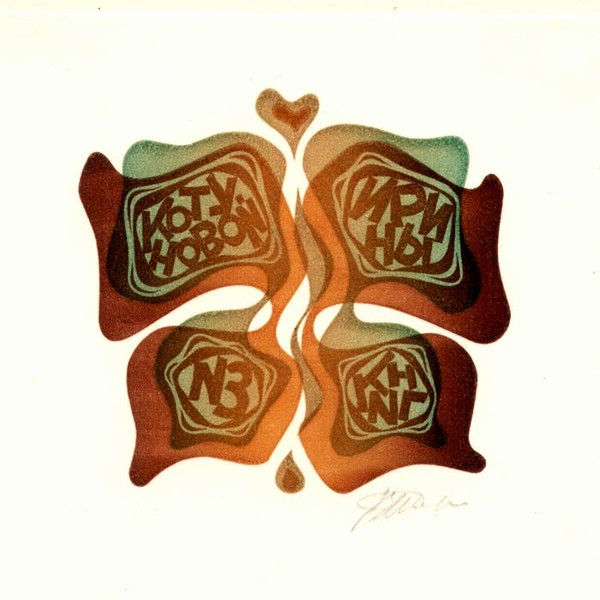
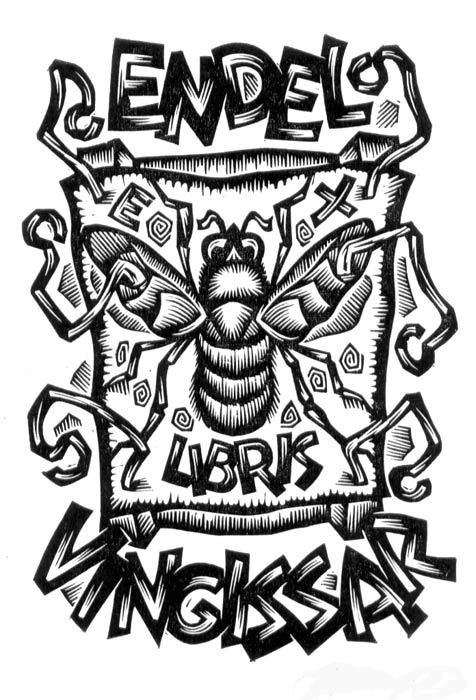
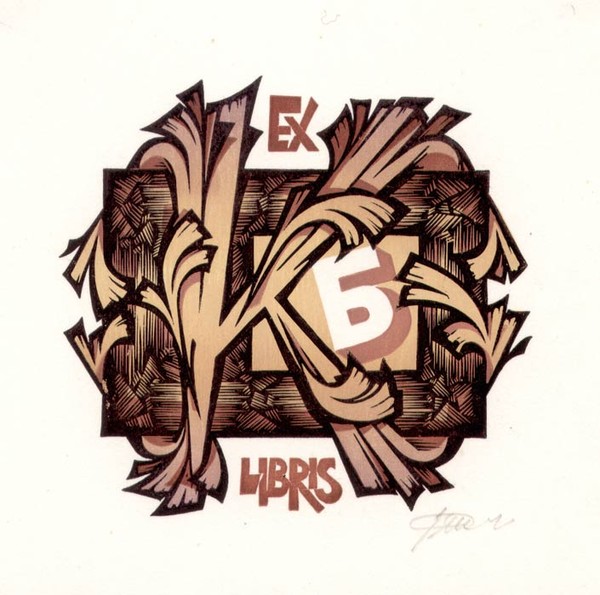
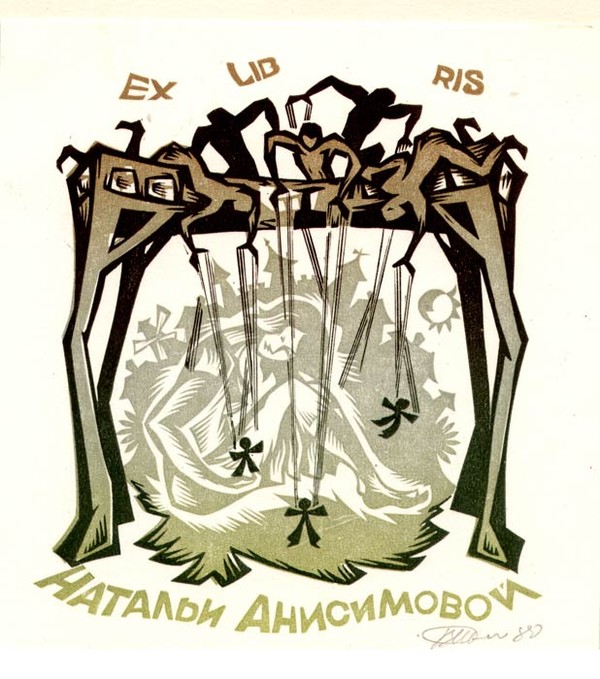
Over a number of years, the artist has been searching for his own artistic and plastic language. His search is difficult but active, overcoming all the complexities involved in understanding the planar and spatial laws of small-format engraving. His mastery of various plastic and engraving techniques was vividly manifested in a cycle of bookplates that may be united under the common title “Typographic.”
Typography is the field in which the paths of image and letter cross and intertwine. Here, the specific nature of graphic art as a visual art finds its full diversity and realisation. It was precisely in typographic engraving that the artist found his individual hand and original style, revealed the artistic, technical and colour themes of his art, and formulated an independent concept in his work on the engraved typographic bookplate. The technical possibilities in Sheiko’s typographic compositions are the principal form of his artistic thought and, at the same time, an expression of plastic and colour ideas. In his very first typographic works, the graphic artist finds interesting contrasts which, through their content and formal techniques, intensify the perception of the theme and cause it to resonate with greater emotional acuity. These developments include the bookplates....
The first serious works reveal that the formal construction of the bookplate, technical complication and consistent interpretation of the genre disclose new aspects of the contemporary bookplate from one sheet to the next. When studying the construction and development of the artist’s bookplates, one understands that one work introduces the theme while the next completes it. Even V. Sheiko’s typographic engravings reflect the warmth of relationships: the relationship between artist and bibliophile, artist and customer. He devised the multifaceted themes of the bookplates he created and the many-sided relationships between poetic metaphors and the visual arts.
V. Sheiko’s graphic miniatures are highly artistic visual compositions, conceived down to the smallest detail and organically incorporated into the book as a distinctive design element. In them, he found a rhythm of contrasts between time and style, emotional tensions and associations, literature and theatre. They are constructed according to a contemporary understanding of the laws of composition, expressing with concision and on multiple levels the compelling concerns of the artist, the bibliophile and the viewer.
Vladimir Sheiko’s art is organic. This art helped him create many fine bookplates and develop his own graphic manner. It was a path of unexpected turns and discoveries. The near future may reveal a different artist, Sheiko, to us.