Alexander Makovey
Born on 27 March 1954.
Village of Sîngerei, Drăgănești District, Republic of Moldova.
From 1971 to 1978, he studied at the Chișinău Art School and the Moscow Polygraphic Institute.
Member of the Union of Artists of the Republic of Moldova.
A calligrapher - a person who works with letter images - must be able to read very well, to read deeply and to express himself through a distinctive script.
When one looks closely at the calligraphic works of Alexander Makovey, one feels masculine energy and force. And it is not a matter of plastic solutions, nor of mastering new compositional methods for constructing a calligraphic opus, but of the perception of an artist-calligrapher who is steeped in and breathes lettering. And no matter how he thinks or writes, he is nevertheless reflected in his entirety in his artistic writing, in his attitude toward life, toward himself, toward the grapheme. He cannot hide from his temperament, from his theme, from his aesthetics.
Makovey undertook his first exercises in lettering back in the 1980s. Behind him are exhibitions and awards in the field of calligraphic writing. But his style began to take shape toward the end of the 1990s.
Working with lettering requires good taste and a sense of line from the artist. Calligraphy can be mastered only through thoughtful daily practice. Alexander Makovey moves within the current of contemporary calligraphy, using the methods of free script more and more frequently. The artist is engaged in searching for new, free methods of executing the calligraphic opus. The handwritten scripts employed fulfill a variety of tasks, from artistic expressiveness to emotional mood.
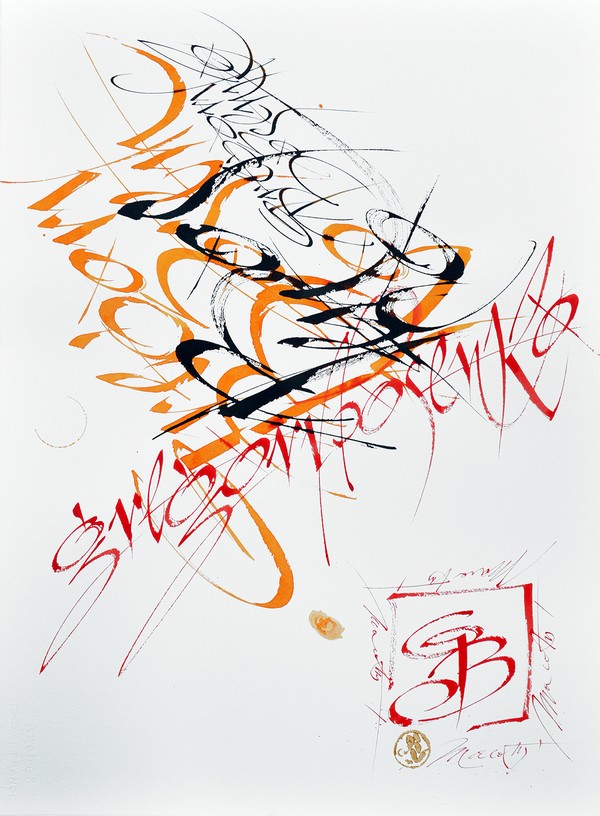
While working on the technique of writing, the author refined his working methods. It is important to him that the space between letters be harmonized, possess its own subordinate rhythm and be as expressive as the principal inscription. The outline of a letter interests him as much as what fills it inside. He does not contemplate the construction of the letter, whether it is calligraphically ornate or ascetically drawn, written small or large; what matters to him is how the plane is organized, how the colored surface is mastered, and how the semantic content is perceived. His compositions are maintained within the framework of a plastic concept and figurative construction. The inscription often passes or grows into a certain abstraction, in which the lettering artist uses a system of endless interweavings and connections, attempting to relate graphically the calligraphically written lines, ligatures and graphemes, drawn signs and symbols, while at the same time achieving clarity and ease of reading. All this against a background of such calligraphic flourishes and overlays.
The author achieves interesting effects by alternating lines written horizontally and vertically. At times, he skillfully incorporates portraits or human figures into the composition, thereby intensifying a particular semantic emphasis and richness of content.
The author intensifies the effects in his calligraphic opuses through the use of color, often by the monotype method. The lettering artist resolves the theme associatively, creating a festive, multicolored composition with a dominant color and with collage on the plane. Such works include cycles of large-format sheets in mixed media: “Numele meu” - 2007, “Poesis” - 2007, “Omagiu Ch. Baudelaire” - 2008.
Alexander Makovey’s stylistic renewal took place in recent years while working on the Old Testament and the Gospel. Upon engaging with this theme, the author understood that the Holy Scriptures dictate their own requirements. Through the artist’s individual approach, nuances of intonation are defined, while other dimensions and a sense of time are revealed.
Among the best works of this period are lettering title compositions, in which the author creates interesting calligraphic works, weaving meaningful drawings into them. In his written illustrations, the artist finds commensurability in proportions and rhythm, in the harmonious unity of the whole and the particular, and in color contrasts and nuances. The solutions of the various graphic elements are simple, rigorous and harmonious.
Another direction that A. Makovey is attempting to master is the Psalter, the biblical book of the Old Testament consisting of 150 songs. The title and the entire linguistic element of the text encourage the search for writing of an elevated graphic character.
The calligrapher uses Old Church Slavonic script and slightly deforms the letters in his own manner, thereby conveying his own sound of the words and intonation of reading. The lettering sheet begins to be read as an associative image, as a concealed image with inexplicable content. For the emotional resonance of the text, the calligrapher uses classical methods employed in old chronicles - an initial or decorated initial letter as the opening part of a text, title or paragraph. In these sheets, the artist demonstrates the accomplished use of this accent, with knowledge of the history of lettering art. In the organization of space on the plane, a unified tension arises in the inscription, in the image and in the additional ornamental details. In addition to ornament, he introduces free flourishes into the compositions to emphasize and intensify the biblical text.
This emerges at the level of emotional intuition, as a distinctive illustration, and is distinguished by its original configuration, size and color.
The breadth of the artist’s calligraphic interests is also demonstrated by books of various purposes designed with lettering. From the poetry “Limba noastră” by Alexei Mateevici and “The Story of Divine Deer” by Ion Hadârcă to catalogs and bookplates. All these works possess the author’s emotional atmosphere and intonation. Handwritten scripts actively participate in organizing the space between the illustrations, where there are neither lifeless nor empty areas.
Alexander Makovey’s entire calligraphic gallery introduces one of the principal spheres of the artist’s creative work and vividly demonstrates the possibilities for the development of the art of lettering.