“Economic Review,” No. 14 (990), 22 February 2013 /p. 18/ Chișinău
One of the Last of the Mohicans...
On 20 April, the 90th anniversary of the birth of Ilya Trofimovich Bogdesko will be celebrated.
People’s Artist of the USSR, full member of the USSR Academy of Arts, laureate of the State Prize of the Moldavian SSR. Laureate and diploma winner of republican, all-Union and international book art competitions.
Gold Medal of the International Book Competition in Leipzig, Bronze Medal of the International “Book-75” Competition, I. Fedorov Diploma.
He had two homelands - Moldavia and Russia. He loved them both.
Born in 1923 in a Moldavian village, as a ten-year-old boy he learned the fundamentals of the Russian language in a settlement for exiles in the Kirov Region. In those same parts, he became an artist, graduating from the Kirov Art School, to which he walked 170 kilometers in bast shoes in order to enroll...
During the war, his artistic talent proved to be in demand. Working from the latest reports, the young man drew maps of military operations for headquarters, sometimes going for days without sleep.
Immediately after demobilization, he entered the I. E. Repin Leningrad Institute of Painting, Sculpture and Architecture, where he studied under the most renowned masters of Soviet book graphics, K. I. Rudakov, S. V. Priselkov and G. D. Epifanov.
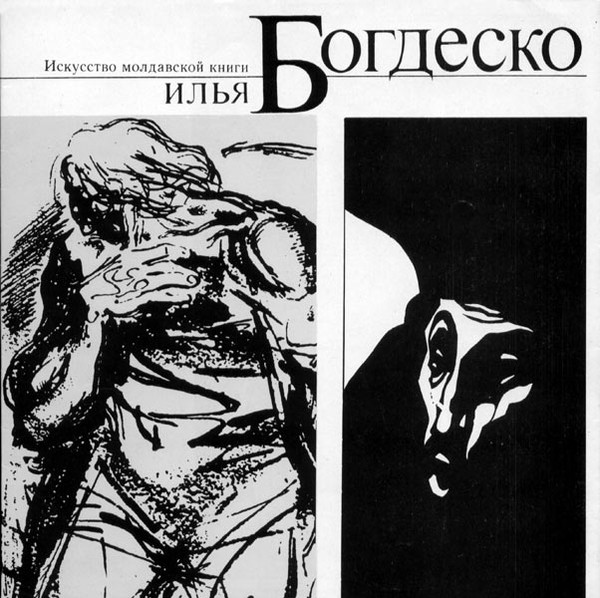
In 1953, Ilya Bogdesko returned to his native Moldavia, where his brilliant career as a graphic artist took shape. After becoming chief artist of the “Cartea Moldovenească” publishing house in 1961, he organized weekly seminars for young artists on its premises and raised Moldavian book art to a level that was very high for its time. Wishing to show young masters how one should work on a book, Ilya Trofimovich created his famous “The Purse with Two Coins,” for which he developed not only the illustrations, but also the entire text, written calligraphically.
At the age of forty, I. Bogdesko received the title of People’s Artist of the USSR. For twelve years, he headed the Artists’ Union of Moldavia, and in 1984 he became a full member of the USSR Academy of Arts. His name appears in every art encyclopedia as that of a master of book graphics and a calligrapher. In the rating of Russian artists, he was assigned world-class status.
This man’s entire life was subordinated to a single passion - illustrating books. He designed approximately 100 publications. If he participated in any competition or book exhibition, he was usually first and only occasionally - second. His “arsenal” included the Gold Medal of the International Exhibition of Book Art in Leipzig, the Grand Gold Medal of the USSR Academy of Arts, and the Ivan Fedorov Diploma. Many of his graphic cycles have long since become classics of the book illustration genre and have shaped more than one generation of readers. His “record” of illustrations places the names of Creangă and Sholokhov, Alecsandri and Pushkin, Gogol and Gorky, Korolenko and Negruzzi side by side. Specialists consider his illustrations for Pushkin’s “The Gypsies” to be the finest. He worked with an almost incredible delight on illustrations for the works of such sarcastic authors as Jonathan Swift and Erasmus of Rotterdam. Probably because he himself loved life and was a wit.
For the last two decades, he lived quietly in the southwestern part of St. Petersburg, reducing his world to the confines of a small apartment that also became his studio. Here he continued to create as before, no longer distracted by public and political activity, finishing what he had begun and carrying out small commissions.
At the age of eighty, he found the strength and courage to head the Academy of Arts’ Creative Workshop of Graphic Art, where he taught art and calligraphy to talented young people who adored him.
At the international “bukva:raz!” type-art competition in 2002, his italic script became one of the winning entries. In 2005, the master published the textbook “Calligraphy,” devoted to his beloved art of beautiful writing. Owing to its immense popularity, it was immediately reissued.
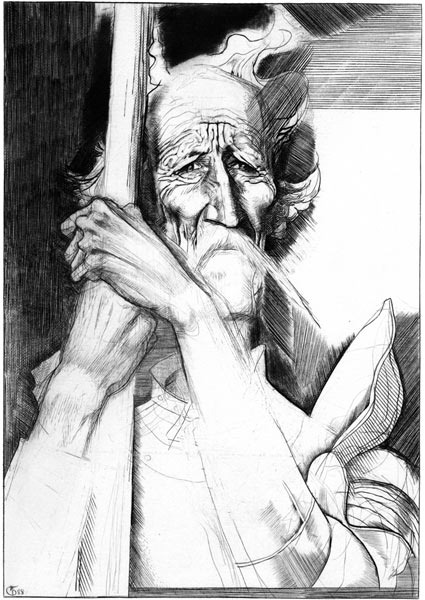
However, the principal undertaking of the creator’s life was the illustrations for “Don Quixote” by the Spanish writer Cervantes, on which the master worked for twenty-five years. He completed most of them while living in Chișinău. He finished the work in St. Petersburg, as a true continuator of the cause of the great romantic Don Quixote, no longer having a commission for it... Thirty-nine sheets in the genre of burin engraving! Few artists dare to work in this labor-intensive old technique. How he dreamed of seeing his “Don Quixote” published! Unfortunately, this great and wise book, ranking second in popularity worldwide after the Bible, appeared with his illustrations only in 2010, and the Knight of the Sorrowful Countenance - Ilya Trofimovich Bogdesko - was not destined to see it.
I learned this artist’s name long before I met him personally, when, while still studying at the Chișinău Construction Technical School, I acquired an album of drawings entitled “At the Sixth World Festival” (1958) by I. Bogdesko, who was unknown to me. At the technical school, I studied drawing and painting, but there was little literature for this course, and here was an entire album of sketches and portraits executed in pencil! Somewhat later, I bought the book “Drawings by Ilya Bogdesko” (1963), published by “Cartea Moldovenească.” It became my constant reference book throughout my studies at the technical school and the institute. I managed to collect almost all the editions issued in print runs with illustrations by I. Bogdesko, from “The Purse with Two Coins” by I. Creangă (1962) and “Miorița” (1967) to “Master Manole” by V. Alecsandri (1986). While studying the artist’s illustrations, I reflected upon the creator’s lettering designs and contemplated his profound and serious approach to the subject and material. I owe much to my teacher, under whom I studied “by correspondence” and whom I still try to emulate in my creative work today.
Our close acquaintance began in 1979. I was offered a major project involving the publication of ten booklets on the art of Moldavian book graphics and bookplates. Ilya Bogdesko was among the selected book illustrators. At that time, I headed the Small Graphic Art and Bookplate Section of the Society of Book Lovers of Moldavia and had developed the basic layouts for these two series, but the material had to be selected jointly with the authors and laid out.
I remember working with Ilya Trofimovich, his reflections, his attitude and his requirements for composition. I conceived the layout as simple and architectonically clear, selected the works I liked, included them in a version of the layout and went to the maestro for my “examination.”
Bogdesko carefully examined the proposed version and gently, without constraining the authorial principle, began to reflect upon ease of perception, space within the format, the organic quality of the layout and a different selection of illustrative material. In conclusion, he delicately expressed the wish that a new version be considered precisely in this vein.
Ilya Bogdesko’s art was never the province of only a narrow circle of graphic-art connoisseurs. His admirers include bibliophiles, amateur artists and professionals. In his illustrations one can find elegant wit and social criticism, lyricism and tragic conflicts, an interweaving of the classical with the wandering spirit of modernity. The creative work of a great master is built upon these contrasts and oppositions. Bogdesko is an adherent of realistic art who perceives the world soberly. The leitmotif of his work is the human being and victory over dehumanization. Having formulated this, I decided to construct the new layout so that behind the work one could sense the creator, behind the form - the content, behind the subject - the artist’s thoughts and feelings. I took into account academic margins, lightness and oppositions, the delicacy of the underlays, and went to him for approval.
The layout was accepted, the typeface was agreed upon, and a proposal was made to consolidate what had been accomplished. Ilya Trofimovich took out a large bottle bearing the calligraphic inscription “Spiritus vini,” executed, of course, by the artist himself. We sat until late, deriving immense pleasure from our communication. The master showed me dozens of copper plates, spoiled and made over again and again. He engraved until he achieved the particular result he needed. The maestro described how exactingly he searched for and developed one composition or another, how, when developing a new subject, he studied new possibilities, new materials and tools necessary for creating the illustrations for that work. I was amazed by such a profound approach to the profession and by his incredible capacity for work, by the searches and discoveries, and by the countless drawings and sketches I saw. Only those that satisfied the creator remained; the rest were ruthlessly burned in the fireplace, radiating the heat of intellect and titanic labor. These were unforgettable lessons in the graphic craft, the lofty “craft of Bogdesko.”
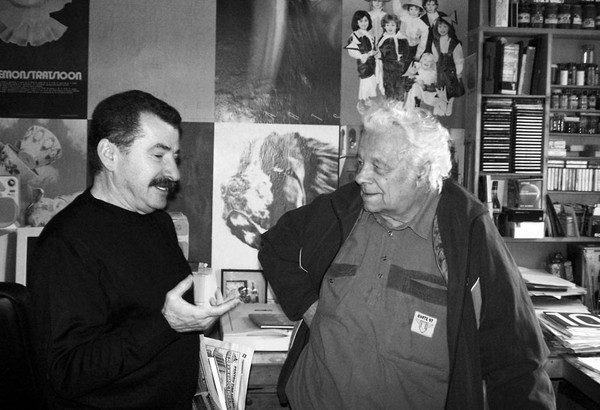
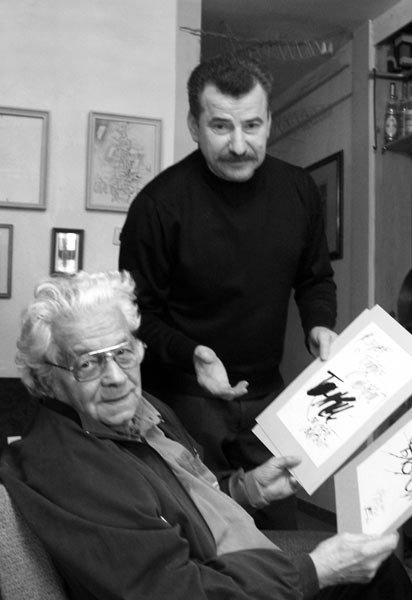
Our last meeting took place in December 2005, during the master’s final visit to Chișinău. In the middle of a winter day, sunny in the Moldavian manner, Ilya Trofimovich entered my studio with a parcel in his hands. Having taken off his coat, he immediately presented me with a gift one could only dream of: the recently published book “Calligraphy,” issued in St. Petersburg, the fruit of his many years of research and writing, as well as the catalog of his latest exhibition, held in St. Petersburg.
I leafed through the magnificently illustrated book, while Ilya Trofimovich reflected aloud upon the art of handwritten script in old and modern times, its aesthetic charm, and how we perceive it as a source of inspiration. The master said that we all drink from this unclouded spring, a priceless heritage - the only professional school for those who wish to perfect their skill, to which even the most experienced masters turn for knowledge and refined taste.
I listened and thought that all this should be heard by a large audience - both beginning and experienced artists. The illustrations included in this publication could have been reproduced by the master’s hand in master classes conducted by him, which, unfortunately, were not practiced in our country, and yet it is precisely illustrators and designers of children’s books who shape the taste and worldview of our children! It is precisely advertising artists who largely determine what the aesthetic face of our city will be!
We drank tea and examined my lettering opuses. It was important for me to see and, even more importantly, to hear the opinion of so demanding a “viewer.”
While examining old engravings in the “Old Chișinău” postcard set, we marveled at what our city and its architectural structures had once been like, structures that, unfortunately, have not survived to the present day. And we conversed as equals.
As he was leaving, he invited me to the presentation of a unique edition that he had brought with him. It was a handwritten book with original engravings, Cervantes’s “Don Quixote.”
“Don Quixote” has already been published, and now this autobiographical book by Ilya Trofimovich Bogdesko, whose publication he also dreamed of, is appearing. It recounts the difficult life path of this remarkable artist and allows us to look into his creative studio.
The philologist Natalia Bagrova from St. Petersburg was a friend and, for several years, to some extent the secretary of I. T. Bogdesko. They became acquainted in March 2001, when a public organization that Natalia was assisting asked her to find a calligrapher to fill a handmade folio. All the illustrious names from St. Petersburg’s past and present had to be inscribed in it. Through the city’s Artists’ Union, N. Bagrova established contact with the master, and they immediately became friends. She liked the atmosphere of creativity that reigned in the home of Ilya Trofimovich, who lived a different life and had different interests from most of the people around her. Above the worktable, his back was almost always bent, turned away from the world like that of Raskolnikov in the portrait he had created. He was a brilliant draughtsman and, at times, a talented performer: he could expressively read aloud passages from his memoirs and recite entire chapters from his beloved Dante’s “Inferno” from memory. He loved playfully altering words. For hours, he could show his drawings and engravings and open the world of art to the listener, explaining, for example, what he saw in the paintings of his favorite artists, Rembrandt or Piero della Francesca.
In 2006-2007, N. Bagrova compiled a draft version of the autobiographical book “Circle after Circle,” begun by Ilya Trofimovich. The text was based in part on Ilya Trofimovich’s personal correspondence, his manuscripts and diary entries, to which the maestro gave her access. While preparing materials for the archive of the Academy of Arts, Natalia organized the household archives of books, magazines and newspapers. Materials on the work of I. T. Bogdesko were traced on the Internet, and the audio recordings of their conversations and the texts of films made about him were transcribed. It was possible to find information about the fate of Trofim Prokofievich Bogdesko, Ilya Trofimovich’s father, and also to obtain an extract from his exile case file from the Nizhny Novgorod archives. All the material formed the basis of the publication offered to the reader. This book exists today largely thanks to the compiler’s labor.
In most sources, the master gives interviews, so there were practically no problems with the author’s manner of speech. As a philologist, N. Bagrova believes that the proposed “stitching of the text” better suits the “cut” of an academic person than a fragmented, disjointed narrative that is difficult to perceive and contains many repetitions, although it proved impossible to avoid them entirely. Slight “tailoring to the figure” in some places in no way distorted the meaning of what was said. All the more so because the maestro himself believed that “variegation and fragmentation, as well as stylistic diversity, are inadmissible in a book,” although this was said about its artistic design.
In the autumn of 2009, N. Bagrova visited Moldova for the first time, where she stayed at the invitation of Lyudmila Fedorovna Osinsyan, Ilya Trofimovich’s cousin. Together they visited Bogdesko’s addresses in Chișinău and traveled to Ilya Trofimovich’s birthplace in Transnistria - the village of Botușani. Natalia remembers Milya - as Lyudmila Fedorovna is called in the family - and her daughter Natasha Vityuk with great warmth and thanks them for their heartfelt hospitality, as well as for their assistance in translating newspaper and magazine materials from Moldavian into Russian.
After the visit to Moldova, a second version of the book emerged. In 2012, it was finally completed and is now presented to the reader.
I had the honor of designing this publication.
This book contains not only the fate and life’s summation of the remarkable artist Ilya Trofimovich Bogdesko, of whom Russia and Moldova are proud, but also the fate of these countries themselves and of their art. It is also extremely valuable that it can provide young illustrator-artists with a number of practical recommendations on the art of book design. But readers less knowledgeable in this field will also find it interesting to look into the creative studio of a graphic artist, where book illustrations are created.
Ilya Trofimovich Bogdesko’s autobiographical book “Circle after Circle” is a joint Russian-Moldovan project, with the direct participation of the Russian Center for Science and Culture in Chișinău.