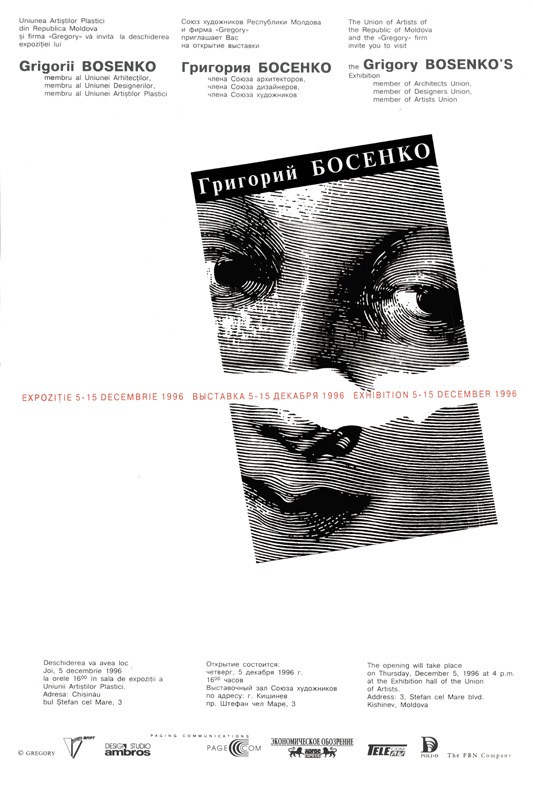
Exhibition - Chișinău, 5-15 December 1996, “25 Years of Creative Work”
As human society and its culture develop, aesthetics also change-that is, the sensory perception of the surrounding world. Along with general progress, the range of processes and phenomena in art that become the object of a new aesthetics, the object of a new culture and new concepts, expands. There are certain relationships between art in practice and theoretical trends (leaving aside the influence of ideology). A process of evolutionary change and the emergence of a new aesthetics and new art is underway. Creative work seeks its own new concepts and definitions, taking into account the factors of dependence on and pressure from earlier styles, in order to manifest itself in the near future through new intellectual development, in a new category. At each stage, it is necessary to analyze one’s work and avoid naturalistic copying and the traditional construction of a work’s scenario, returning each time to the beginning by searching for new forms and solutions. Each new work should contain a small element of inventiveness ready to multiply in subsequent works. The visual reproduction of the surrounding world must be reformed in accordance with its time, just as our lives change. It is interesting to turn to unexplored paths in art, even when they are synthesized. One must follow instinct, immerse oneself in non-objective forms, and then overcome and transform them into frozen elements that associatively remind us of the world in which we are present, spontaneously continuing to discover connections through which space flows into light, forms into texture, and textures into poetry. The author creates works that combine several art forms: architecture, sculpture, painting, and music, attempting to approach the problem of creativity synthetically, like the masters of the Middle Ages. Breathing a world of symbolic archetypes into his creative work, studying and interpreting them in his own way, and drawing inspiration from the work of artists ranging from Leonardo and Bruegel to Gaudí, El Lissitzky, and Picasso, the artist attempts to liberate an enslaved creative intellect, to attain freedom of subject, personal power of perception, maximum mastery, and a worldview. When developing the three-dimensional-frontal space of paintings, it is necessary constantly to remember the dialectics of the accidental and the regular. An analysis of the destruction of form (the plane) is capable of creating a new, unknown configuration possessing diverse possibilities for emotional comprehension. In this flow, it is difficult to understand the messages of morphologism, difficult to trace the archetypal and culturological methods of the work and the intellectual and psychological processes of the human being. The construction of the narrative composition is characterized by the use of free reconstruction, multiple angles and turns, the personal lighting of each image or form, differences of scale, and simultaneity-that is, the combination on the picture plane of images, each of which exists in its own time. The use of polyphonic relationships-structural, thematic, and compositional-is characteristic, together with multiple interdependent relationships such as linear, textural, and chromatic ones. Technique is a full-fledged component of a work, alongside subject and composition. One must strive for the illusion of a complete fusion of form, light, color, and technique. All this distinguishes a work not so much by its manner of execution as by its worldview, subjective interpretation of the subject, and unconventional figurative and visual thinking. This applies to any themes, subjects, and directions, from neorealism to abstraction, from primitivism to applied art.